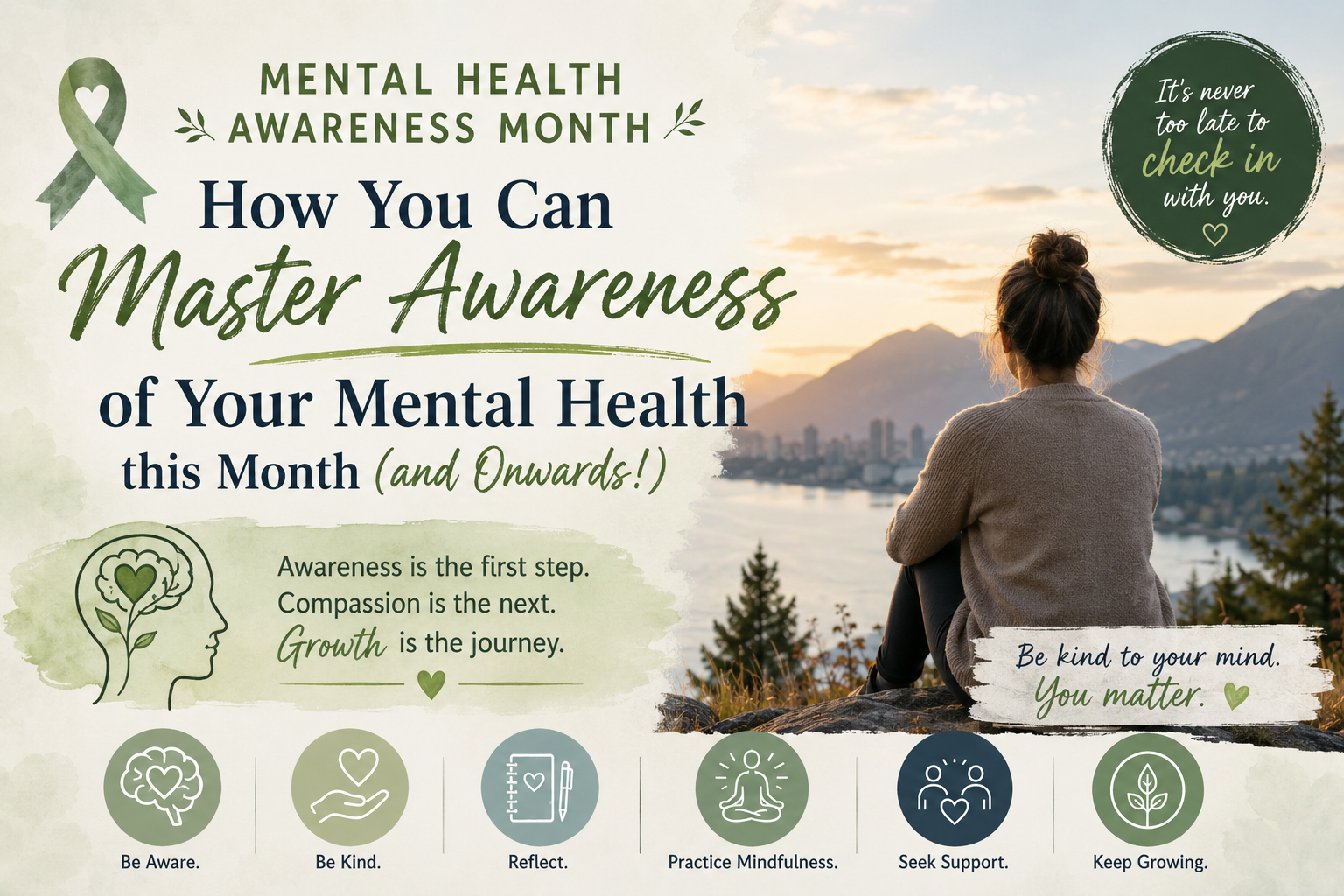
Mental Health Awareness Month: How You Can Master Awareness of Your Mental Health this Month (and Onwards!)
May is Mental Health Awareness Month. “What is Mental Health Awareness Month?” you might be wondering ... it’s an annual mental health campaign largely in the US and Canada that is devoted to reducing stigma, educating the public, and connecting people to essential resources.
Though May is coming to an end, it’s never too late to reflect on the importance of mental health. According to the Canadian Mental Health Association Lower Mainland, approximately one in two people will have experienced or developed a mental health disorder by the age of 40. In British Columbia, 20–26% of the population (roughly one million individuals) experience a mental illness each year1, with Vancouver residents reporting poorer mental health compared to the rest of the province.2
Now, I could list a series of resources, anecdotes, or “top ten” tips about mental health, but there are already countless blogs and articles that do exactly that. Instead, I invite you to reflect with me on the word at the heart of this campaign: ‘awareness’.
We are living in a time where conversations around mental health are at an all-time high.3 Despite growing awareness, Canadians’ mental health, particularly young Canadians, is severely impacted by conditions such as anxiety.4
Many of us are feeling constantly inundated with information surrounding mental health. While this can be helpful, it can also be overwhelming.
That is why I invite you to join me in taking a step back from all the noise and focus on that little thing called ‘awareness’.
The phenomenon of awareness has captivated humans for many years, and is studied by psychologists, philosophers, theologians, spiritual gurus, and even neuroscientists.
From a psychological standpoint, awareness is the cognitive ability to feel, perceive, and be conscious of the events, objects, and sensory world around you.
There are many different types of awareness: self, situational, social, and spatial, among others. The kind I want to focus on here is self-awareness.
Self-awareness is the cognitive ability to tune into your own inner and outer world, and identity. It can be divided into internal self-awareness (knowing your own values, beliefs, and interests) and external self-awareness (knowing how others perceive you and your impact on others).
Self-awareness is powerful because it allows you to do what many people are too afraid to do: evaluate your full self, the good, the bad, and the not-so-pretty.
We are all made up of these parts and none of us are perfect. What we all should focus on is striving to be the best version of ourselves.
Naturally, the first step toward becoming the best version of yourself is to look inwards.
You know the saying: the first step to fixing your ‘problem’ is admitting that you have a problem to begin with. What I’m talking about here is a less pathologizing version of this step.
In order to become the best version of yourself, you have to first be willing to look inward.
Self-aware people possess many advantages over those unwilling to tune into themselves, including better ability to manage behaviours and adapt to situations.
When someone is self-aware, they are better able to recognize how they respond to stress, interact with others, make decisions, and affect people around them.
This often leads to better emotional regulation, healthier relationships, and more intentional choices.
There is truly nothing quite like looking inward.
What are some easy ways to become more self-aware?
It’s best to start by engaging in regular, non-judgemental self-reflection. Take time to think about your day or week and the feelings and interactions throughout.
This can include asking yourself questions:
- What have I been thinking about most recently?
- What were the most common thoughts or feelings I had this week?
- What seemed to trigger feelings of stress or anxiety?
- What were some positive things I did that made me feel better?
Another easy way is to pay close attention to your emotions, especially when they change.
Paying attention to emotions like anxiety, frustration, excitement, or withdrawal can help a person understand triggers and unmet needs.
Other ways include journalling, self-reflecting with a trusted loved one, practicing mindfulness, thinking about your personal values and beliefs, and engaging in therapy or counselling.
Ultimately, mental health is highly complex, and there is no universal one-size-fits-all approach to improving it.
Self-awareness is also deeply personal and varies from one individual to another.
In that sense, if there is ever a “one-size-fits-all” aspect to self-awareness, it is that it is always uniquely shaped by the individual themselves.
Again, even though Mental Health Awareness Month 2026 is coming to an end, your awareness, self or otherwise, doesn’t have to.
References
- https://lowermainland.cmha.ca/impact/influencing-policy/facts-and-figures/
- https://www.cbc.ca/news/canada/british-columbia/metro-vancouver-mental-health-bc-1.7120747
- https://magazine.howard.edu/stories/the-growth-of-mental-health-awareness
- https://mentalhealthcommission.ca/catalyst/the-age-of-anxiety/