Mindfulness, Rumination, and Self-Awareness: What Actually Builds Emotional Regulation
Somewhere along the way, self-awareness became shorthand for emotional health. Know your attachment style. Name your triggers. Understand where the anger really comes from. All of that is genuinely useful, and none of it is wrong. But a lot of people do this work faithfully, build real insight into their own patterns, and still find themselves snapping at a partner, spiraling before a work presentation, or lying awake replaying a conversation that ended hours ago. If you have ever wondered why understanding yourself so well hasn't made the feelings any easier to sit with, part of the answer is that mindfulness, self-awareness, and rumination are three different things that often get mistaken for one another, and only some of that inner work actually changes what happens in your body in the moment.
This article looks at what separates mindfulness from rumination, what separates self-awareness from emotional regulation, whether emotions can be overthought, when self-reflection turns into something less useful, whether thinking is ever enough to resolve anxiety on its own, and why the way couples repair after conflict tends to matter more than how well either partner understands themselves individually.
Mindfulness vs. Rumination: What Actually Separates Them
Mindfulness is the practice of noticing a thought or feeling as it arises, naming it, and letting it move through without grabbing onto it or trying to argue it into submission. It is present-focused. It does not require the thought to be resolved, explained, or fixed. A mindful response to anxiety before a big presentation might sound like: I notice I am anxious. My chest feels tight. That is uncomfortable, and it will likely ease once I get started.
Rumination is a repetitive, backward-looking cycle of thinking that tries to analyze, explain, or undo distress, and typically ends up feeding it instead. A ruminative response to the same anxiety might sound like: Why do I always get like this before presentations? What is wrong with me? Everyone else seems so calm. I probably came across as nervous last time too, and people definitely noticed.
The content can look similar. Both involve noticing anxiety and thinking about it. What differs is the shape of the thinking. Mindfulness widens; it makes room around a thought so it can be observed rather than believed completely. Rumination narrows; it pulls the same material through the mind again and again, usually with a critical edge, and rarely arrives anywhere new. Research on repetitive negative thinking consistently links rumination to higher rates of anxiety and depression, while mindfulness-based approaches are associated with reduced symptoms of both, largely because of this structural difference rather than the topic being thought about.
Self-Awareness vs. Emotional Regulation: Two Different Skills
Self-awareness is the ability to notice an emotion, name it accurately, and trace it back to something that makes sense. It is a cognitive skill, built largely through reflection, therapy, journaling, or simply getting older and paying closer attention. Emotional regulation is something else entirely. It is the ability to influence the intensity, duration, and expression of a feeling once it has already shown up, in real time, often while your heart rate is climbing and your thinking brain is losing some of its usual authority.
These two skills draw on different systems. Insight lives mostly in slower, more deliberate thinking. The physical experience of an emotion, the flushed face, the tight chest, the urge to leave the room, is driven by faster and more automatic processes that do not wait for permission from the analytical mind. A person can have a precise, well-rehearsed explanation for why a certain tone of voice makes them defensive, and still feel the defensiveness arrive at full strength the next time they hear it. Knowing the mechanism does not disconnect the wiring.
This is why so many people describe feeling stuck despite years of self-reflection. They are not failing at the work. They are doing one half of it exceptionally well while the other half, the part that actually changes what happens in the body under stress, has never been directly practiced. There is also a quieter reason insight sometimes fails to translate into change: self-awareness only does its job when it is paired with accountability. It is possible to understand a pattern in exhaustive detail and still use that understanding to excuse it rather than shift it, explaining away a harsh comment as just how I am when I'm stressed instead of owning the impact it had. Real self-awareness includes a willingness to look at your own part plainly, without letting pride talk you out of what you already know.
Can You Overthink Your Emotions?
Yes, and it is more common than most people realize. Overthinking an emotion usually means replaying a feeling or an event repeatedly while searching for a level of certainty or control that thinking alone cannot actually provide. Why did I feel that way. What does it mean about me. Could I have prevented it. Round and round, often late at night, often without landing anywhere.
This is different from processing an emotion. Processing tends to happen once, or a few times, and moves toward some kind of resolution: an insight, a decision, a sense of acceptance, even if the feeling itself has not fully gone away. Overthinking, by contrast, cycles without resolution. The same ground gets covered again and again, and each pass tends to add a little more distress rather than a little more clarity.
Emotions themselves are information, not problems to be solved through sheer analytical effort. A feeling can often be more accurately understood by noticing it, naming it, and allowing it to inform your next step, rather than trying to think your way completely around it before you are willing to feel it at all. Overthinking frequently functions as a subtle form of avoidance: as long as you are still analyzing the feeling, you do not actually have to sit with it.
Feel Your Feelings, Don't Think Your Feelings
There is a paradox at the center of rumination that is worth sitting with: the more a person thinks about a personal or relational problem, the less likely they often are to actually solve it. This runs counter to how most of us were taught to handle distress, which is to think harder, analyze longer, turn the problem over one more time until it finally gives something up. But repetitive analysis tends to narrow attention rather than expand it, and problem-solving, especially the kind involving another person, generally requires the opposite: enough openness to consider new information, a different angle, someone else's perspective. Rumination closes that door even as it feels like it is trying to open it. In relational conflict specifically, that closed door is often held shut by pride. Rehearsing the version of events where you were right and the other person was wrong can feel like problem-solving, but it is usually ego protecting itself, and it rarely leaves room for the kind of accountability that actually repairs a relationship.
Part of what gets missed in all that thinking is the emotion itself. An emotion is, at its core, a signal, a piece of information telling you that something mattered, something hurt, something needs attention. Thinking about a feeling is not the same as feeling it. A person can spend hours mentally dissecting why they feel hurt, embarrassed, or afraid, without ever actually letting themselves feel hurt, embarrassed, or afraid. That avoidance has a cost. Emotions that are analyzed instead of felt tend to linger, resurfacing again and again, precisely because the signal was received but never actually processed.
Feeling an emotion, as uncomfortable as that can be, tends to work more like a wave than a puzzle. It rises, it crests, and if it is allowed to move through without being fought, analyzed, or pushed away, it falls again on its own. This is closer to how emotions were built to work: to communicate something, then pass, making room for whatever comes next. Fighting that rhythm by trying to out-think it does not make the wave smaller. It tends to keep pulling the person back out to where the water is roughest.
A still pond offers a useful image for the difference. Emotion, left alone, is like still water: given enough time and space, it settles, and what was stirred up becomes visible again at the bottom. Every additional round of overthinking is another stone thrown into that water, another ripple. The pond never gets the chance to still, and the very clarity a person is chasing through all that thinking keeps getting pushed further out of reach by the thinking itself. Perseveration, the technical term for getting stuck repeating the same thought or behaviour past the point of usefulness, works the same way. At some point, more thinking is not more insight. It is simply more ripples.
None of this means emotions should be ignored or suppressed. It means something closer to the opposite: let the feeling in, listen to what it is signaling, and resist the urge to immediately convert it into an analytical project. Sometimes the most useful thing a person can do with a painful feeling is genuinely nothing at all beyond letting it be felt, trusting that, much like a wave or a settling pond, it has a natural course to run. Time, and the simple act of allowing an emotion to move through rather than around, does a great deal of the healing that overthinking keeps promising to deliver and rarely does.
Why Self-Reflection Is Healthy, Until It Isn't
Self-reflection, at its best, is one of the more valuable habits a person can build. It supports learning from mistakes, noticing patterns in relationships, and making more intentional choices instead of purely reactive ones. The research on self-reflection generally links it to better decision-making and emotional regulation, but only under certain conditions.
Healthy introspection tends to share a few features. It is curious rather than accusatory. It has a natural endpoint rather than running indefinitely. And it moves toward something: an insight, a plan, a decision, or at minimum, a sense of having genuinely understood something you did not understand before. Something like, that meeting really threw me, I think it's because I felt unprepared, next time I'll ask for the agenda in advance, is reflection doing its job. It names the feeling, locates a plausible cause, and lands somewhere useful.
Unhealthy self-reflection, which is really rumination wearing reflection's clothing, borrows the same material and does something different with it. It becomes repetitive rather than exploratory, revisiting the same ground without new information. It becomes critical rather than curious, focused on judgment rather than understanding, tending to ask why did this happen to me or what is wrong with me rather than what can I do differently. And it becomes open-ended, with no clear stopping point, because there is no answer being sought so much as a feeling being relived. Rumination can also quietly protect the ego rather than confront it, circling around how you were wronged or misunderstood while skipping past the harder, more useful question of what you might own in the situation. Genuine accountability tends to feel different from the inside: less dramatic, less self-punishing, and considerably shorter, because it is aimed at a next step rather than at proving a point to yourself.
A few markers tend to distinguish the two in practice:
- Direction: healthy reflection moves toward resolution or acceptance; rumination moves in circles.
- Tone: reflection tends to be curious; rumination tends to be critical or accusatory.
- Time: reflection has a natural stopping point; rumination can go on for hours or resurface for days.
- Aftermath: reflection usually leaves some sense of clarity, even if the situation is unresolved; rumination usually leaves a person feeling worse than when they started.
The subject matter is rarely the deciding factor. Thinking about a difficult conversation, a mistake at work, or a strained relationship is not inherently unhealthy. What matters is whether the thinking is producing clarity and movement, or simply producing more of the same discomfort on a loop. In relationships specifically, healthy reflection usually includes an honest look at your own part in what happened, not just the other person's. Setting ego aside is often what separates reflection that leads to real accountability from reflection that simply builds a case.
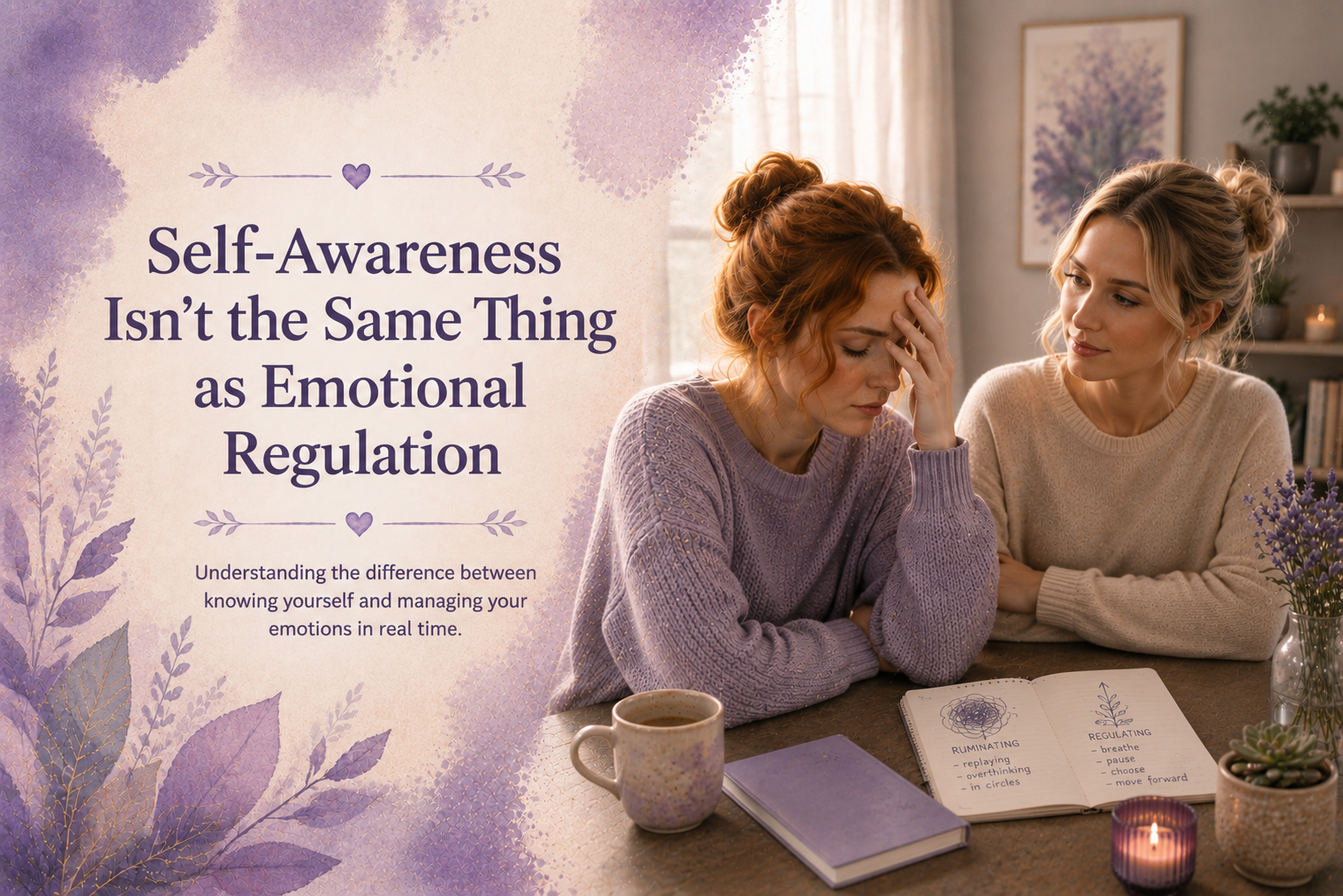
The Psychology of Self-Awareness: When Looking Inward Helps (and When It Hurts)
Psychologists sometimes distinguish between two related but different capacities: insight, the ability to understand your own thoughts, feelings, and motivations, and rumination, the tendency to dwell on distress without resolving it. Both involve looking inward. Only one tends to correlate with better wellbeing.
What separates them often comes down to psychological distance, the capacity to observe a thought or feeling as something you are having, rather than something you fully are. A person with more psychological distance might think, I am noticing a lot of self-doubt right now. A person with less might think, I am not good enough, full stop, no observer in sight. The first framing leaves room to examine the thought. The second one simply becomes the thought. Pride can distort that distance in relationships too, collapsing "I made a mistake" into either "I am always the problem" or "I did nothing wrong," neither of which leaves much room for honest accountability.
Looking inward tends to help when a few conditions are present: some distance from the thought itself, a focus on understanding rather than judgment, and an eventual movement toward action or acceptance rather than an indefinite loop. It tends to hurt when it is driven primarily by anxiety, when it fixates on why something happened rather than what to do about it, and when it happens entirely alone, without any outside perspective to interrupt a pattern that feels, from the inside, like it is working.
This last point matters more than people often expect. One of the reasons rumination is so persistent is that it can feel productive while it is happening. It has the texture of effort, of trying to figure something out. Without an outside perspective, it can be genuinely difficult to tell from the inside whether you are working through something or simply wearing a groove into it.
Can You Think Your Way Out of Anxiety?
Partially, and only up to a point. Understanding where anxiety comes from, a stressful childhood dynamic, a pattern of catastrophic thinking, a nervous system that learned early to expect the worst, can genuinely reduce some of its intensity. Naming a fear accurately is not nothing. But anxiety is not purely a thought. It is a physiological state, involving a real, measurable activation of the body's alarm system, and that system does not always take instructions from the parts of the brain doing the reasoning.
This is why a person can know, with complete cognitive clarity, that a plane is statistically one of the safest ways to travel and still feel their pulse climb the moment the seatbelt sign turns on. The logical conclusion and the physical alarm are running on separate tracks. Trying to argue the alarm down with facts alone often does not work, because the alarm was never listening to facts in the first place.
What tends to work better is pairing insight with something that speaks directly to the body: slower, longer exhales than inhales, which signal safety to the nervous system faster than reasoning does; movement, which gives excess activation somewhere to go; and grounding techniques that bring attention back to the present moment rather than the anticipated future. None of this replaces the value of understanding where the anxiety comes from. It simply recognizes that insight and physiological calm are two different destinations, and getting to one does not automatically get you to the other.
A quick way to notice the difference in yourself: if you can explain exactly why you're anxious but the anxious feeling in your body hasn't moved at all, that's not a failure of insight. It's a sign the next step is a body-based one, not another round of analysis.
Emotional Repair: The Skill That Predicts Relationship Success
Much of the popular advice about relationships focuses on communication style, love languages, or how well two people understand each other's inner worlds. All of that matters. But one of the more consistent findings from decades of relationship research is that the presence of conflict itself is a weak predictor of how a relationship fares over time. Nearly every couple argues. What separates the relationships that last from the ones that erode is what happens in the minutes, hours, or days after the argument ends.
That process is called repair: the deliberate, sometimes awkward work of reconnecting after a rupture. It can look like naming what happened without minimizing it, taking responsibility for your own part even while still feeling hurt, or simply sitting back down next to someone after a fight to signal that the disconnection is not permanent. None of this requires either partner to fully understand the psychological roots of the conflict. It requires the regulation skills to come back into contact with someone while still feeling raw, which is a considerably harder task than understanding, in hindsight, what the fight was really about.
An authentic apology tends to be where accountability and regulation meet, and it works in both directions. Offering one, and meaning it, is rarely comfortable, since it usually requires setting pride aside and owning something before the sting of the conflict has fully faded. But that act of ownership tends to lower a person's own physiological arousal almost as reliably as it lowers their partner's, because it replaces the effort of self-defense with something simpler to carry. Receiving a genuine apology does similar work for the other person, signaling that the disconnection has been seen and taken seriously, which is often what allows the nervous system to stand down. An apology that is mostly about ending the discomfort quickly, without real ownership behind it, rarely produces that same calming effect for either person.
Couples who repair well are not necessarily the couples who fight the least or who have done the most introspective work individually. They are the ones who have built a reliable practice of returning to each other afterward, again and again, until it becomes less something they have to think through and more something the relationship simply does. That practice is regulation in action, two nervous systems learning, over time, that disconnection is survivable and does not have to be the end of the story.
Why Therapy Is More Than Just Thinking About Your Problems
A common misconception about therapy is that it is essentially a more expensive version of what a person could do alone: sitting somewhere, talking or thinking about what is bothering them. In practice, therapy differs from independent reflection, and from rumination, in several important ways.
Therapy is structured. Evidence-based approaches, whether cognitive behavioural therapy, dialectical behaviour therapy, acceptance and commitment therapy, or mindfulness-based approaches, are built around specific techniques designed to interrupt unhelpful thought patterns rather than simply revisit them. A therapist is trained to notice when a client's reflection has quietly turned into rumination and to redirect the conversation before that pattern reinforces itself further.
Therapy also provides an outside perspective that rumination, by definition, cannot offer. A big part of what keeps rumination going is the absence of any input that might challenge the loop from outside the person's own head. A skilled clinician can ask the question that reframes an entire pattern, notice a distortion the client cannot see from inside it, and offer language for an experience that has never quite had a name before.
Finally, therapy is oriented toward change, not just understanding for its own sake. Insight matters, but insight without a next step tends to stay exactly that: insight, sitting on a shelf. Therapy typically pairs understanding with concrete skills, whether that means learning to notice rumination as it begins, practicing mindfulness techniques that create distance from difficult thoughts, building body-based tools for anxiety, or developing a reliable practice of repair in a relationship. Emotional regulation, like any other skill, is built through practice rather than granted to people who have simply thought about themselves long enough. The goal is not to think about your problems more thoroughly. It is to change your relationship to them, and to what happens in your body when they show up.
Common Questions About Mindfulness, Self-Awareness, Rumination, and Emotional Regulation
What is the difference between mindfulness and rumination?
Mindfulness is noticing your thoughts and feelings as they arise without judging them or rushing to fix them. Rumination is a repetitive, backward-looking cycle that tries to analyze or resolve distress and usually ends up amplifying it instead. Mindfulness widens awareness and lets a thought pass through. Rumination narrows attention and loops the same thought without resolution.
Is self-awareness the same thing as emotional regulation?
No. Self-awareness is the ability to notice and name what you feel and why. Emotional regulation is a separate skill: the ability to influence the intensity, duration, and expression of a feeling once it has already arrived. Insight lives largely in the thinking parts of the brain, while the physical experience of an emotion is driven by faster, more automatic systems that do not always respond to understanding alone.
Can you overthink your emotions?
Yes. Overthinking emotions usually means replaying a feeling or event repeatedly while searching for certainty or control that thinking alone cannot provide. This differs from processing an emotion once and moving forward. Repeated cycling through the same feeling, without new insight or a change in behaviour, tends to intensify anxiety and low mood rather than resolve them.
Why is self-reflection healthy until it isn't?
Self-reflection is healthy when it is curious, time-limited, and leads somewhere, whether that is new understanding, a decision, or a change in behaviour. It becomes unhealthy when it turns repetitive, critical, and open-ended, with no endpoint and no forward movement. The line usually is not the topic itself but whether the thinking produces clarity or simply repeats distress.
If you recognize yourself in this pattern, doing a lot of thinking without ever quite landing anywhere, or understanding your triggers in detail and still feeling swept away by them, that gap is common and workable. Pacific Maple Psych Centre offers individual therapy in Vancouver focused on building emotional regulation skills, not just insight.
Book a SessionCan you think your way out of anxiety?
Understanding where anxiety comes from can reduce its intensity somewhat, but anxiety is a physiological state as much as a cognitive one, and the body's alarm system does not always respond to reasoning. Pairing insight with body-based tools, such as paced breathing, movement, or grounding, tends to work better than thinking alone.
What is emotional repair and why does it matter for relationships?
Emotional repair is the process of reconnecting with a partner after conflict or disconnection. Research on long-term relationships has found that whether or how well couples repair predicts outcomes more reliably than how often, or how intensely, they argue in the first place.
Can emotional regulation be learned as an adult?
Yes. It is a skill set built through practice rather than a fixed trait. Therapy approaches such as dialectical behaviour therapy, acceptance and commitment therapy, and mindfulness-based approaches specifically target the ability to tolerate, name, and shift emotional states, and many people see meaningful change with consistent practice, regardless of how long they have relied on insight alone.
Building the Other Half of the Work in Vancouver
None of this is an argument against self-reflection. Understanding your patterns is genuinely valuable, and it is often the first step that makes the rest of the work possible. But if insight alone has not been enough, that is not evidence that you have not reflected deeply enough, or that more thinking will eventually get you there. It is a sign that regulation, the part that lives in the body and in practiced response rather than in explanation, is the piece still waiting to be built.
At Pacific Maple Psych Centre, we work with clients on both halves of this: how to recognize when reflection has quietly become rumination, how to practice mindfulness skills that create genuine space around difficult feelings, how to bring body-based tools to bear on anxiety, and how to move from understanding a pattern to actually changing what happens when those feelings show up in real time, at work, in relationships, or in the middle of an ordinary day that suddenly feels like too much. In relationship work specifically, that often means learning to set ego aside long enough to take honest accountability for your own part, rather than staying stuck defending it.
A Final Thought
If you have ever finished a long stretch of thinking about something and felt more tangled up than when you started, or if you can explain your patterns in detail and still feel swept away by them in the moment, that is worth paying attention to. It does not mean you are overthinking on purpose, or that you have failed at understanding yourself. It usually means the loop found you before you noticed it had started, or that the half of the work living in your body has not yet had the chance to catch up with the half living in your mind.
Mindfulness is not about thinking less, and emotional regulation is not something insight alone can hand you. Both are about changing your relationship to the thoughts and feelings you already have, so that attention becomes something that serves you rather than something that traps you.
You do not have to sort this out alone.
Pacific Maple Psych Centre offers individual therapy in Vancouver for anyone looking to understand their own mind more clearly and build the practical skills to change how their patterns feel in the moment. Whether you are just noticing the gap between insight and regulation or ready to work through it, we are here to help.
Book Your Session TodaySources
- American Psychological Association. (2022). Rumination: A cycle of negative thinking.
- American Psychological Association. (2023). Emotion regulation. https://www.apa.org/topics/emotion-regulation
- Association for Contextual Behavioral Science. (2020). Acceptance and commitment therapy: An overview.
- Association for Psychological Science. (2019). The science of mindfulness.
- Gottman, J. M., & Gottman, J. S. (2017). The natural principles of love. Journal of Family Theory & Review, 9(1), 7–26.
- Harvard Health Publishing. (2021). When self-reflection turns into rumination.
- Harvard Health Publishing. (2024). Understanding the stress response. Harvard Medical School. https://www.health.harvard.edu/staying-healthy/understanding-the-stress-response
- Kross, E., & Ayduk, O. (2017). Self-distancing: Theory, research, and current directions. Advances in Experimental Social Psychology, 55, 81–136.
- Linehan, M. M. (2014). DBT skills training manual (2nd ed.). Guilford Press.
- National Institute of Mental Health. (2024). Anxiety disorders. U.S. Department of Health and Human Services. https://www.nimh.nih.gov/health/topics/anxiety-disorders
- Nolen-Hoeksema, S. (1991). Responses to depression and their effects on the duration of depressive episodes. Journal of Abnormal Psychology, 100(4), 569–582.
- Nolen-Hoeksema, S., Wisco, B. E., & Lyubomirsky, S. (2008). Rethinking rumination. Perspectives on Psychological Science, 3(5), 400–424.
- Verduyn, P., Delvaux, E., Van Coillie, H., Tuerlinckx, F., & Van Mechelen, I. (2009). Predicting the duration of emotional experience: Two experience sampling studies. Emotion, 9(1), 83–91.
- Watkins, E. R. (2018). Rumination-focused cognitive-behavioral therapy for depression. Guilford Press.