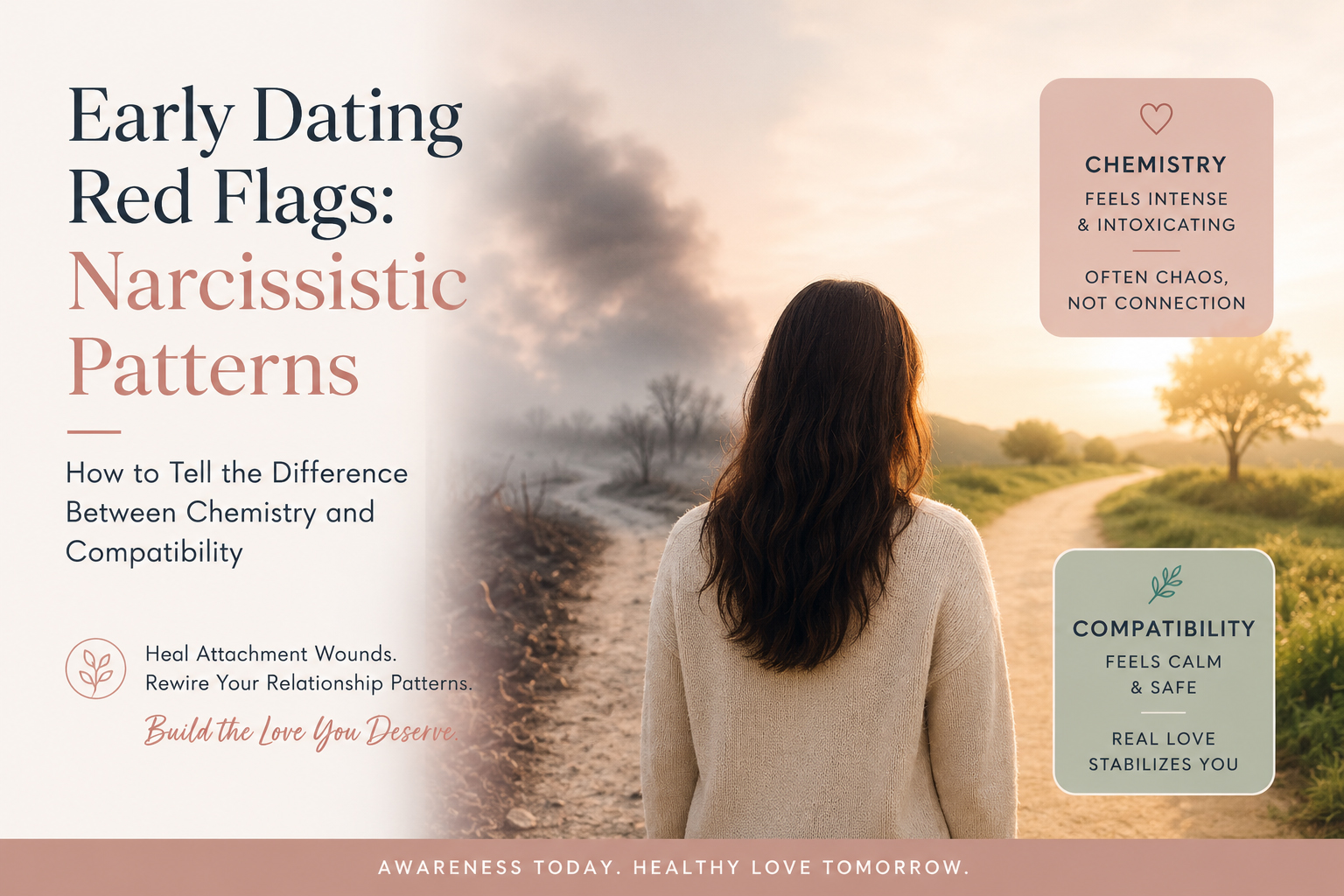
Early Dating Red Flags: Narcissistic Patterns
Have you ever met someone who felt electrifying right away? The chemistry felt undeniable. The connection felt intense. You could not stop thinking about them. It felt exciting, consuming, even magical.
And yet weeks or months later, you realized what felt like extraordinary chemistry was actually emotional chaos.
Meanwhile, someone emotionally available, consistent, and kind may have felt underwhelming. Too calm. Too predictable. Maybe even boring.
For many people with trauma histories, attachment wounds, or past unhealthy relationships, this pattern is more common than people realize. Our nervous systems often gravitate toward what feels familiar rather than what feels healthy.
When emotional inconsistency shaped early experiences, the subconscious mind can begin associating activation with love. As a result, emotionally unavailable or unhealthy partners can feel magnetic while healthier partners initially feel unfamiliar.
The good news is these patterns can change. Therapy can help heal attachment wounds, increase self-awareness, strengthen boundaries, and support the rewiring of subconscious relationship patterns so safety no longer feels boring and chaos no longer feels like chemistry.
When Intensity Is Not Intimacy
One of the biggest misconceptions in dating is believing chemistry automatically means compatibility.
Healthy love, while it may begin with intense excitement, often develops slowly. It builds trust, emotional safety, mutual understanding, and consistency over time.
Unhealthy dynamics frequently move much faster.
- Pushing premature intimacy
- Entitlement to your time/body/emotions
- Oversharing trauma early to bond quickly
- Constant need for admiration
- Fishing for compliments
- Subtle superiority, fragile ego
- Victim stories about every ex
- Frequent defensiveness
- No accountability
- Blame shifting
- Boundary pushing framed as love
- Expressions of love unusually fast
- Intense connection without truly knowing each other
Rare love stories do happen where people find themselves in an intense connection, a whirlwind romance, that turns out to be healthy and happy. The key is distinguishing between excitement due to a rare "soulmate match" versus red flags that may be difficult to see when wearing rose-tinted glasses.
Behavioural Red Flags During Dating
- Love bombing (excessive attention, gifts, intensity)
- Feigned mirroring of your personality
- Obsession with image/status
- Validation seeking
- Triangulation involving exes or admirers
- Jealousy disguised as protection
- Control disguised as care
- Boundary testing
- Creating emotional dependency
- Hot and cold behaviour
- Performative affection publicly
- Acting differently privately
Problematic Communication Patterns
- Interrupting
- Monologuing
- Conversations always become about them
- Poor listening
- Deflects feelings
- Minimizes your emotions
- Invalidates gently at first
- Gaslighting lightly early on, worse later
- Subtle put-downs disguised as "jokes"
- Backhanded compliments
- Negging to break your confidence
The Nervous System Test
After dates, ask yourself:
- Do I feel calm or charged?
- Do I feel safe or stimulated?
- Do I feel settled or obsessed?
- Do I feel grounded or euphoric?
- Do I feel regulated or dysregulated?
Many people mistake nervous system activation for chemistry. They are not always the same thing.
Narcissistic Charm Versus Healthy Attraction
Narcissistic Charm Often Feels Like:
- Intensity, especially sexual intensity
- Euphoria, rush
- Urgency, obsession
- Fantasy bonding, future faking
- Sexual intensity early
- Feeling chosen rather than known
- Anxiety mixed with excitement
- Dopamine-driven highs/addictive feelings
- Performance-based closeness
Body feeling: activated, euphoric, restless, hyper-alert.
Bonding style: fast and consuming.
Healthy Attraction Often Feels Like:
- Calm, ease
- Safety
- Warmth
- Curiosity
- Consistency
- Stability
- Respect
- Reciprocity, genuine mutual interest
- Slow trust building
- Predictability, emotional regulation
- Secure presence
Body feeling: grounded, relaxed, steady, open.
Bonding style: slow and deep.
You feel seen rather than sold to. You feel known rather than idealized. You feel safe rather than emotionally destabilized.
The Boundary Test
Set a small boundary early and watch the response. Healthy partners generally:
- Respect boundaries
- Adjust behaviour
- Stay consistent
- Avoid punishment
- Avoid taking limits personally
Unhealthy patterns may involve:
- Guilt
- Pressure
- Sulking and withdrawal
- Anger or jokes about the boundary
- Manipulation or charm to override
- Repeated testing of limits
Boundaries are your most magical tool in the dating world. Boundaries reveal character faster than chemistry does.
Trauma Bonding Versus Secure Attachment
Attraction does not automatically mean compatibility. Sometimes attraction reflects familiarity.
People healing attachment wounds often ask:
- Why do healthy partners feel boring?
- Why do I lose attraction when someone treats me well?
- Why do emotionally unavailable people feel exciting?
These questions do not mean something is wrong with you. They may point toward attachment patterns deserving healing and compassion.
Healthy love feels safe. Safe can feel unfamiliar.
Unhealthy dynamics often feel intoxicating. Intoxicating can feel addictive.
If it feels like a drug, it may not be attachment. It may be trauma bonding chemistry.
Real love does not hijack your nervous system.
It stabilizes it.
Healing Relationship Patterns Through Therapy
Relationship patterns can change.
Therapy can support healing attachment wounds, strengthening boundaries, improving nervous system regulation, increasing self-awareness, and helping individuals build healthier relationship templates.
Healing is about helping your nervous system recognize that safety and attraction can coexist. Because lasting connection is not built through chaos; it is built through safety, trust, consistency, emotional intimacy, and secure attachment. Over time, healthy love often stops feeling boring and begins feeling deeply fulfilling.