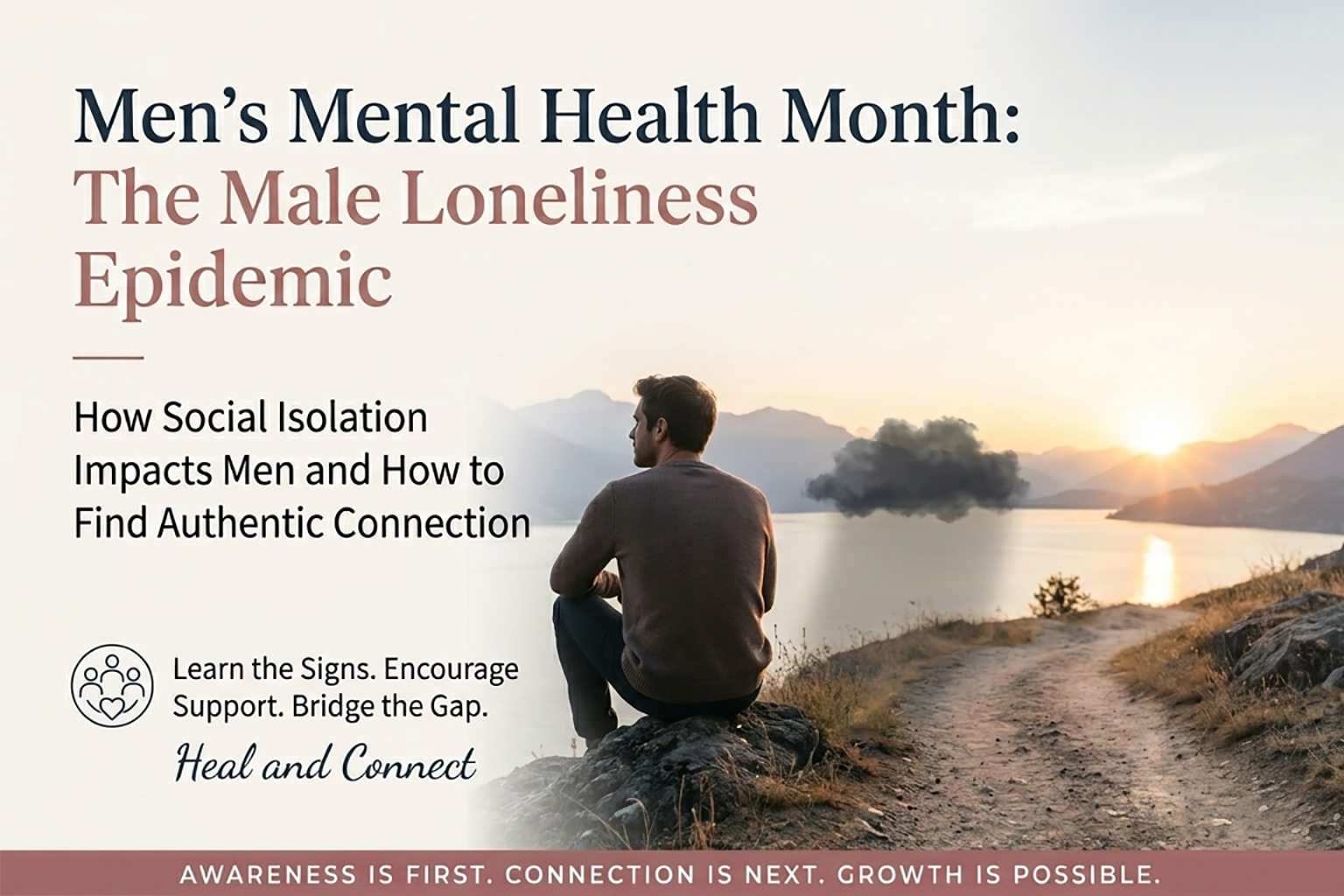
Men’s Mental Health Month: The Male Loneliness Epidemic
June is Men’s Mental Health Month, a time that highlights something many men quietly experience but rarely talk about: emotional isolation. While men are often expected to appear independent, resilient, and self-sufficient, research shows that many are struggling with a growing sense of loneliness, disconnection, and lack of emotional support.
This is both a personal challenge and a public health concern, and it is showing up in relationships, dating patterns, workplaces, and overall wellbeing.
The Male Loneliness Epidemic: What the Data Shows
Loneliness has been increasing across many populations, but men consistently report weaker social support networks than women.
- A study from the American Psychological Association found that men are less likely than women to report having close confidants outside of romantic partners, highlighting a growing gap in emotional support systems.
- Pew Research shows that men are significantly more likely to report having fewer close friendships than they did a decade ago, reflecting increasing social isolation.
- The World Health Organization identifies loneliness and social isolation as major risk factors for depression, anxiety, cardiovascular disease, and early mortality.
In Canada, similar patterns are reflected in mental health reporting. Men are less likely to seek therapy, less likely to talk openly about emotional distress, and more likely to experience untreated depression until it becomes severe.
This creates a feedback loop: less emotional expression leads to fewer deep friendships, which increases isolation, which then makes emotional expression even harder.
Why Men Struggle With Dating More Today
Modern dating has changed significantly over the last two decades. There are more choices, more digital platforms, and more independence in how people form relationships.
One major shift is that women now have significantly greater financial independence than in previous generations. This is a positive and important social development. It also changes relationship dynamics.
With more independence, many women are more selective in choosing partners, prioritizing emotional maturity, communication skills, stability, and compatibility rather than financial necessity.
For many men who were never taught these skills, this can feel confusing or discouraging.
But it is important to be honest: this is not a sign that men are “failing.” It is a sign that relationship expectations have evolved. And evolution simply requires adaptation.
Mental Health, Neurodiversity, and Relationship Challenges
Different mental health and neurodevelopmental profiles can shape how men experience relationships and loneliness. These are not flaws, but differences that can affect communication, emotional regulation, and connection.
ADHD and dating
Men with ADHD may struggle with:
- Forgetting messages or commitments unintentionally, even when caring deeply about the relationship
- Emotional impulsivity during conflict, leading to fast reactions or difficulty pausing
- Difficulty sustaining routines in relationships such as consistent texting or planning
- Periods of hyperfocus followed by emotional or communicative withdrawal
These patterns can sometimes be misinterpreted as lack of interest, even when that is not the case.
Autism and relationships
Men on the autism spectrum may experience:
- Difficulty reading social cues, tone, or subtext in dating situations
- Emotional overwhelm in intense or fast-moving relationship dynamics
- Social exhaustion after extended interaction or social events
- Preference for direct communication that may be misunderstood by partners
These differences can sometimes lead to misunderstandings in dating, even when intention is genuine connection.
Depression and emotional withdrawal
Men experiencing depression may demonstrate:
- Social withdrawal and reduced motivation to initiate dating or communication
- Loss of interest in intimacy or emotional connection
- Emotional numbness or disconnection rather than sadness alone
- Low self-worth that impacts confidence in dating
This can make relationships feel distant or impossible, even when desire for connection is still present.
Anxiety and relationship overthinking
Men with anxiety may struggle with:
- Overanalyzing texts, tone, delays, or perceived rejection signals
- Fear of rejection that leads to avoidance of dating initiation
- Reassurance seeking in relationships that can create tension
- Difficulty relaxing into connection due to constant mental scanning
Trauma and emotional protection patterns
Men who grew up in emotionally unsafe or abusive environments may develop protective strategies such as:
- Emotional shutdown or avoidance of vulnerability in relationships
- Hyper-independence and difficulty relying on others emotionally
- Controlling behaviours that mask deeper fears and vulnerabilities
- Difficulty trusting intimacy due to past emotional injury
Sometimes these kinds of behaviours lead to labels in the dating world such as “narcissistic” or "avoidant", as men's coping mechanisms around unmet emotional needs and early attachment wounds can be misunderstood as a reflection of character, when really that is someone who needs professional support.
Why “Failure” Thinking Keeps Men Stuck
One of the biggest barriers to improving dating outcomes and mental health is interpretation.
Many men interpret relationship difficulty as:
- “I am not good enough”
- “Dating is rigged”
- “Something is wrong with me”
This can lead to generalizing rejections into global self-worth conclusions, avoidance of future dating attempts, or bitterness and hatred of women.
A more productive frame is viewing relationship difficulty as feedback, information, and an opportunity to develop skills that were never taught.
The difference in mindset is not small. It is often the difference between withdrawal and growth.
Psychology research consistently shows that people who adopt a growth-oriented mindset are more resilient, more adaptable, and more likely to improve outcomes over time. Framing life challenges as opportunities rather than permanent judgments helps people succeed not only in dating, but also in school, careers, and personal development.
Reframing Masculinity: From Isolation to Development
There is a quiet transformation happening in modern masculinity. The old model of emotional suppression is increasingly being replaced by emotional awareness, communication skills, and psychological insight.
The men who thrive today are not necessarily the most dominant or traditionally “successful.” They are often the ones who:
- Develop emotional regulation skills instead of suppressing emotions
- Build self-awareness around attachment patterns and triggers
- Create and maintain real friendships, not just surface connections
- Learn honest communication in romantic relationships
- Seek support early instead of waiting for crisis points
Happiness research consistently shows that strong relationships and social connection are among the strongest predictors of long-term wellbeing. Men who invest in connection tend to report higher life satisfaction overall.
Support, Clarity, and Moving Forward
For men who feel stuck in patterns of loneliness or confusion in dating, structured support can be a turning point.
At Pacific Maple Psych Centre, therapists work with individuals navigating anxiety, ADHD, autism-related challenges, trauma histories, and relationship difficulties. Therapy can help uncover the patterns behind emotional isolation and build practical tools for communication, regulation, and connection.
Psychological assessments can also provide clarity for individuals who have spent years wondering why relationships feel harder for them than for others. Having answers does not solve everything overnight, but it can remove confusion and replace it with direction.
A Final Perspective
Men’s mental health is not defined by weakness. It is defined by visibility, understanding, and willingness to engage with change. The male loneliness epidemic is real, but it is not permanent. It reflects a mismatch between old expectations and modern emotional realities. And mismatches can be solved through learning, adaptation, and connection.
Many men are navigating adulthood without strong models for emotional expression, conflict repair, or secure attachment. At the same time, there is real reason for optimism. Emotional literacy is increasing. Therapy is becoming more accessible and less stigmatized. Conversations about masculinity are evolving. More men are beginning to understand that emotional awareness is not weakness, but adaptability.
When men begin to understand their patterns, whether related to ADHD, autism, anxiety, depression, or trauma history, they are gaining clarity. And clarity creates direction.
The most successful people in life are rarely those who avoid difficulty. They are the ones who interpret difficulty as information rather than defeat.
For men navigating loneliness today, the question is not “What is wrong with me?”
It may be more useful to ask:
“What is this experience trying to teach me about connection, communication, and myself?”