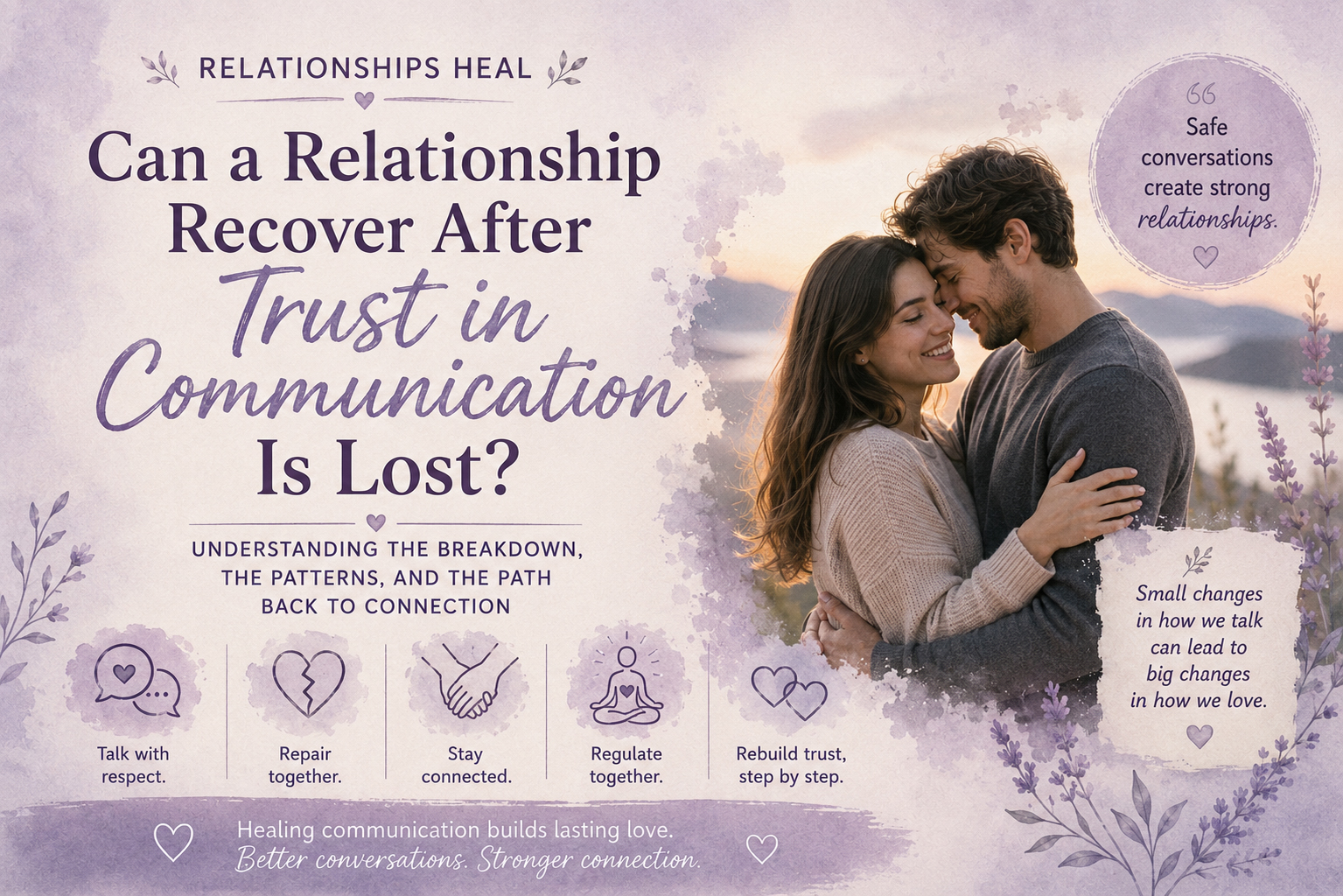
Can a Relationship Recover After Trust in Communication Is Lost?
Most couples do not lose trust in one dramatic moment. It happens gradually, across dozens of smaller conversations that did not go the way either partner needed them to. An argument that ended in silence instead of resolution. A hard topic raised once, met with defensiveness, and never raised again. A pattern where bringing something up costs more than it seems to be worth, so eventually a person stops bringing things up at all. By the time a couple sits down in a therapist's office, they are rarely describing a single betrayal. More often they are describing the slow erosion of a basic assumption: that talking to their partner about something difficult will actually lead somewhere good.
The short answer to whether a relationship can recover after that kind of trust is lost is yes, often it can, but the recovery is not really about apologizing for the last argument. It is about rebuilding confidence in the process of communicating itself, so that the next hard conversation does not carry the same risk as the last several did.
This article looks at what actually breaks when couples describe losing trust in how they talk to each other, why some couples get stuck repeating the same unresolved conflict, and what tends to help when one partner wants to talk everything through while the other needs to withdraw.
The Difference Between Conflict and Emotional Safety in Relationships
Conflict and a lack of emotional safety are often confused for the same thing, but they are not. Conflict is disagreement about something specific: money, parenting, a comment made at a family dinner, how much time one partner spends at work. Every couple has conflict. Its presence is not, on its own, a sign that a relationship is in trouble.
Emotional safety is something underneath the conflict. It is the sense that a person can raise a difficult topic, express a genuine complaint, or admit to something vulnerable without being met with mockery, contempt, stonewalling, or retaliation. A couple can argue frequently and still have strong emotional safety, if both partners generally trust that the argument will stay respectful and that neither of them is trying to win at the other's expense. A couple can also argue rarely and still lack emotional safety entirely, if one or both partners learned somewhere along the way that honesty was not worth what it cost them.
This distinction matters because couples sometimes aim their repair efforts at the wrong target. They try to resolve the specific disagreement, the money or the in-laws or the chores, without ever addressing the underlying question of whether it is safe to disagree at all. A couple can reach an agreement about the dishwasher and still walk away from the conversation feeling less safe with each other than before it started, because of how the conversation was conducted rather than what it was about.
Signs that emotional safety has eroded often show up as behaviour rather than as something either partner says outright: rehearsing a sentence for twenty minutes before saying it, bringing up a concern only after enough frustration has built to override the fear of raising it, or noticing that a partner's body visibly braces before a hard topic starts. None of these signs mean the relationship cannot recover. They mean the nervous system has learned, through repeated experience, to expect something painful from these conversations, and that expectation is exactly what repair work needs to address.
Why Some Couples Can't Repair After Arguments (And How Therapy Helps)
Most arguments that go nowhere share a common shape. Two people disagree about a surface issue, the conversation escalates, one or both partners disengage, and the disagreement is left technically unresolved even after the immediate tension fades. The couple moves on because staying in the discomfort feels worse than dropping it, but nothing about the underlying pattern has actually changed. The same disagreement, or a close variation of it, tends to resurface later, and each time it does, both partners bring a little more accumulated frustration from the last unresolved round.
There are a few reasons couples get stuck in this loop without outside support. Arguments often move too fast for either partner to notice what is actually happening in the moment, so both people are reacting to each other's tone and body language more than to the content of what is being said. Each partner is also usually interpreting the same argument through a different internal narrative, one shaped by their own history, their own sensitivities, and their own assumptions about what the other person's behaviour means, and those two narratives rarely get compared out loud. Left alone, most couples do not have a structured way to slow the conversation down enough to catch either of these things while they are happening.
This is where therapy tends to make a difference that is difficult to replicate without it. A trained couples therapist can slow an argument down in real time, name the pattern as it is happening rather than after the fact, and ask each partner what they actually heard the other say, which is very often not what was actually meant. Over repeated sessions, couples build a shared vocabulary for their own recurring cycle, so that recognizing it becomes possible even outside the therapy room. Therapy does not remove conflict from a relationship. It gives a couple a reliable way to have conflict without it eroding the trust underneath it every time.
When One Partner Wants to Process Everything and the Other Shuts Down
One of the most common patterns couples bring into therapy is a mismatch in how each partner responds to relational stress. One partner wants to talk it through immediately, in detail, until it feels resolved. The other partner wants space, quiet, and time before they can engage at all, and sometimes disengages from the conversation altogether when it starts to feel like too much. This is often described as a pursue-withdraw dynamic, and it is one of the more well studied patterns in couples research, because it tends to intensify itself if left unaddressed.
Neither response is a flaw in character. Both are ways of managing distress that likely developed long before the relationship began. The partner who wants to process everything is often trying to reduce anxiety by resolving uncertainty as quickly as possible, and silence can feel to them like the conversation, and the connection, is simply being abandoned. The partner who withdraws is often trying to manage a nervous system that becomes overwhelmed by intensity, and continuing to engage in that state can feel like being flooded past the point of being able to think or speak clearly.
The trouble is that each partner's coping strategy tends to make the other partner's fear worse. Pursuit can feel like pressure, which pushes the withdrawing partner further away. Withdrawal can feel like rejection, which makes the pursuing partner push harder to reconnect. Round after round, the cycle reinforces itself, and both people end up feeling more alone in the relationship than either intended.
What tends to help is not asking one partner to become the other. It is building a shared plan both partners agree to in advance: a signal for when a conversation needs a pause, an agreed amount of time before it resumes, and a commitment from the partner who needed space to actually return to the conversation rather than letting it disappear. This kind of structure is often easier to build with a therapist's help, since it requires both partners to tolerate something that feels uncomfortable to them personally, in service of a pattern that works better for the relationship as a whole.
If arguments in your relationship keep circling back without resolution, or you and your partner seem to need entirely different things in the middle of a hard conversation, couples therapy can help you understand the pattern and build a way through it. Pacific Maple Psych Centre offers couples counselling in Vancouver for partners working to rebuild trust in how they communicate.
Book a SessionCommon Questions About Rebuilding Trust in Communication
Can a relationship recover after trust in communication is lost?
In many cases, yes, though it depends on both partners being willing to change how they communicate, not only what they say to each other. Since trust in communication breaks down when arguments stop leading anywhere safe, repair usually means rebuilding a sense that hard conversations will not end in shutdown, contempt, or harm. This is slow work, and it is often easier with support from a couples therapist who can interrupt old patterns as they happen.
What is the difference between conflict and emotional safety in a relationship?
Conflict is disagreement about a specific issue. Emotional safety is the underlying sense that a person can express that disagreement without being mocked, dismissed, punished, or abandoned for it. Couples can argue often and still feel emotionally safe, and couples with very little visible conflict can still lack emotional safety if honesty has come to feel too costly.
Why can't some couples repair after arguments?
Many couples cannot repair after arguments because the argument itself was never really the issue, only the latest example of a recurring pattern. Without a structured way to slow down and name what actually happened, the same disagreement tends to resurface. Therapy helps by giving couples a shared framework and a neutral third party who can catch the pattern in real time.
What happens when one partner wants to process everything and the other shuts down?
This is a common pattern, sometimes called a pursue-withdraw dynamic, where one partner seeks more discussion and reassurance while the other seeks distance and calm. Neither response is a character flaw, and each one tends to intensify the other unless the couple learns to recognize the cycle and respond differently, often with a therapist's support.
A Final Thought
Losing trust in how you and your partner communicate can feel like losing something harder to name than trust in a single event. It is not about one broken promise. It is the quiet accumulation of conversations that did not go where either of you needed them to go, until raising something hard started to feel like too much of a risk.
That accumulation can be reversed. It takes both partners choosing, again and again, to have the hard conversation differently than they had it before, and it often takes real support to learn what different actually looks like. A relationship that has lost trust in its own communication is not necessarily a relationship that has run out of time. It is often a relationship waiting for a better way to talk.
Pacific Maple Psych Centre offers couples counselling in Vancouver for partners rebuilding trust and communication after repeated conflict. Whether you are just starting to notice the pattern or ready to book a session, we are here to help.
Book Your Session TodaySources
- Gottman Institute. Research on Conflict, Repair, and Emotional Safety in Couples.
- American Psychological Association. Couples Therapy and Communication Patterns.
- PMC. The Demand-Withdraw Pattern in Couple Interaction: A Review.
- Journal of Marital and Family Therapy. Emotionally Focused Therapy and Attachment Repair in Couples.
- Psychology Today. Understanding Pursue-Withdraw Cycles in Relationships.