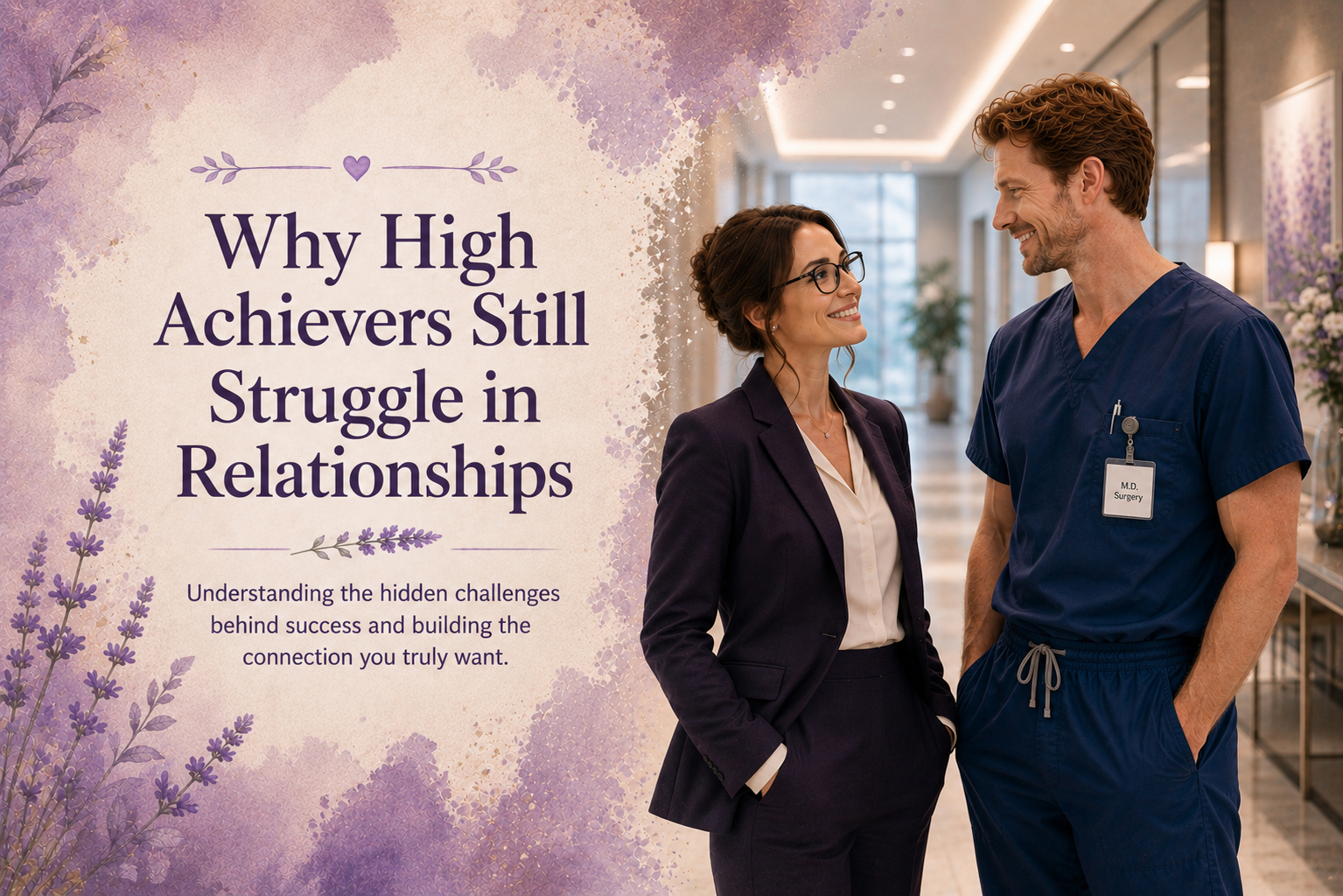
Why High Achievers Still Struggle in Relationships
From the outside, it makes no sense. Here is a person who runs a department, or a company, or an operating room, who can read a room in a boardroom in seconds and negotiate a seven-figure deal without breaking a sweat. And yet at home, that same person is stuck in the same argument with their partner that they have been having for years, unable to figure out why the skills that work everywhere else stop working the moment they walk through their own front door.
This is one of the more common patterns that shows up in therapy with high-performing clients: physicians, executives, founders, lawyers, and other professionals whose careers demand precision, composure, and constant problem-solving. Their competence is real. Their relationships are still struggling. Understanding why requires looking at what actually builds a successful career, and how different that is from what actually builds a close relationship.
This article explains why intelligence and achievement don't automatically protect anyone from emotional blind spots, what makes the relational cost of medicine and executive leadership so specific, and why therapy remains one of the more useful tools available to people who are, by most external measures, already doing everything right.
Why High Achievers Still Struggle in Relationships
Career success and relational success are built from overlapping but distinct skill sets, and most professional environments only train and reward one of them. A demanding career rewards decisiveness, self-sufficiency, and the ability to compartmentalize discomfort long enough to get a task done. A relationship rewards something closer to the opposite: slowing down, tolerating ambiguity, staying present with someone else's feelings even when there is no clear action to take, and being willing to be influenced rather than simply being right.
High achievers often bring their most effective professional habits home without realizing it, because those habits have worked for them everywhere else. Fixing a problem instead of sitting with it. Optimizing a conversation instead of having one. Treating a partner's distress as an issue to resolve efficiently rather than an experience to be understood. None of this comes from a lack of caring. It comes from a well-practiced toolkit that was built for a different job.
When Intelligence Doesn't Protect You From Emotional Blind Spots
Cognitive intelligence and emotional intelligence are not the same capacity, and one does not automatically produce the other. A person can hold multiple advanced degrees, think several steps ahead in a negotiation, and still have very little practiced skill at naming what they feel in the moment, tolerating a partner's anger without becoming defensive, or noticing their own contribution to a recurring conflict.
Part of this comes from how many high achievers were shaped early on. A child who is praised primarily for grades, performance, and problem-solving learns, reasonably, that competence is what earns approval. That lesson builds real strengths, but it rarely builds the specific muscle of sitting with discomfort without immediately trying to resolve or outperform it. By adulthood, the analytical mind is extremely well developed, while the emotional vocabulary needed for real intimacy was never given the same amount of practice.
This gap tends to show up as specific, recognizable patterns in relationships: difficulty identifying feelings beyond broad categories like fine or stressed, a tendency to intellectualize emotional conversations rather than feel through them, and genuine surprise when a partner says they feel unheard, because from the achiever's perspective, the problem was already being handled.
The Apology High Achievers Struggle to Give
Building on the discussion of accountability in our August 2 - 4 posts, the same principles apply directly here, often with extra difficulty attached. A good apology names the specific behavior, carries real remorse, avoids leaning on explanation as a substitute for ownership, and points to what will be different going forward. For someone whose identity rests heavily on being competent and right, that structure can feel dangerously close to admitting failure, which is often why apologies from high achievers either don't arrive at all or arrive wrapped in justification instead of accountability.
The same ego that produces defensiveness can just as easily produce its opposite: a rushed, over-apologetic capitulation meant to end the discomfort quickly rather than actually repair it. The more useful version sits in the harder middle ground, taking real ownership of one's own part without swallowing the entire conflict, and treating the relationship, not the achiever's self-image, as the thing worth protecting.
The Mental Health Challenges of Physicians and Healthcare Professionals
Few professions place a heavier toll on relationships than medicine. Burnout among physicians has been measured at close to half the profession in several large surveys in recent years, with rates climbing higher among certain specialties and notably higher among women physicians than men. That level of chronic exhaustion does not stay contained at the hospital door.
Research has connected physician burnout to relationship strain and to divorce rates that run meaningfully higher than in the general population. Long and unpredictable shifts, the emotional weight of holding other people's crises all day, and a training culture that has historically treated vulnerability as a liability rather than a normal human experience all make it harder to arrive home with anything left to give. Many physicians describe a specific kind of numbness by the end of a shift, an emotional flatness that made sense as a way of getting through a difficult day at work, but that a partner experiences as distance or disengagement.
Spouses and partners of physicians often absorb a secondary version of this strain, reporting their own anxiety and distress in response to a partner's burnout, even when they are not fully aware of what is driving it. The physician, meanwhile, may not recognize how much of their exhaustion is following them home, because in a training environment that rewards endurance, pushing through was never treated as a problem worth naming.
The Relational Challenges of CEOs and Founders
Executives and founders face a different but equally corrosive version of the same problem: structural isolation. Surveys of business leaders have repeatedly found that a large share of CEOs report meaningful feelings of loneliness in their role, and that this isolation is widely seen by those leaders as something that actively hurts their performance and their wellbeing, not just their mood.
Founders describe a particular kind of narrowing as a company grows. Early on, there are peers, cofounders, and mentors to reality-check decisions with. As the business scales, unfiltered feedback becomes rarer, replaced by a more managed version of information filtered through the people who report to them. Many founders also make a deliberate, understandable choice to protect their families from the weight of the business, declining to bring the specifics of a difficult board meeting or a looming layoff home with them. The intention is protective. The effect is often isolating, both for the founder and for the partner who senses something is being withheld but cannot name what.
Survey data on entrepreneurs bears this out concretely: founders consistently report spending significantly less time with their spouse, their children, and their friends than they did before starting their companies, and rate their overall sense of loneliness considerably higher than the general working population. The relational cost of building something ambitious is rarely discussed as openly as the financial or logistical cost, but for many founders, it is the more lasting one.
There is also a quieter mechanism at work, one that organizational psychologists sometimes call the CEO disease: the higher a person rises, the less honest feedback they tend to receive. Employees soften their observations to avoid appearing critical of someone who controls their livelihood, and the leader's own status makes it easier to attribute friction to someone else's misjudgment rather than their own behavior. Research on senior leaders has found that self-ratings of performance and self-awareness diverge further from how others actually see them the higher a person climbs, precisely because accurate, unflattering feedback becomes scarcer the more power a person holds.
This same imbalance tends to follow a founder or CEO home. A person who runs a company rarely encounters anyone in their daily life, outside of a partner, who is willing to name a blind spot without softening it first. When that kind of direct, unfiltered observation arrives from a partner instead, an owner who has grown unaccustomed to unsoftened critique can experience it as disproportionately jarring, even when it is offered gently. Without regular practice absorbing critical input, the instinct is often to defend a decision or a self-image rather than sit with the discomfort of being seen accurately, which can leave the very blind spot the partner was trying to name fully intact, and the partner wondering whether raising it was worth the cost.
The result is a pattern that can compound over time. The less practice a high-status founder has taking in relational feedback without treating it as an attack, the more their partner may learn to soften, delay, or simply stop raising concerns altogether, quietly removing one of the last remaining sources of honest input in that person's life.
Who Should Pay for the Date?
For a couple where both people are financially capable, this question sounds almost trivial. It rarely is. How two partners handle a restaurant bill is often a small, visible expression of a much larger orientation toward money, generosity, and fairness that shapes the relationship far beyond the date itself. A useful place to start is not with a rule, but with a question: when I love someone, how do I naturally enjoy expressing that love? Does generosity feel joyful, like an extension of care? Or does it feel like a ledger that needs to stay balanced?
Research on couples and money consistently finds that how partners talk about and handle shared expenses says more about relationship satisfaction than the actual dollar amounts involved (Papp et al., 2009). Broadly, two underlying mindsets tend to show up, and neither one is inherently wrong.
Marriage 1: "We're a Team"
The guiding question here is: what helps us flourish together? Money is treated as a shared resource in service of a shared life, even when the accounts themselves stay separate. When one partner has a setback, the other's instinct is not to keep score but to think, I've got you. When one partner succeeds, the instinct is, this is wonderful for us.
Couples with this mindset tend to show a higher tolerance for being temporarily unequal, because the underlying expectation is that across decades, life is rarely going to be perfectly even. A few examples make this concrete. One spouse takes maternity leave and loses income; the other doesn't experience that as reduced contribution, but as a shared family investment. One partner starts a risky business, and the other offers financial or emotional support because they believe in the shared future being built. One partner gets a promotion, and celebration comes well before any calculation of what it means for the household ledger.
The underlying belief is that "your wellbeing benefits me". Importantly, this doesn't require merged finances or unlimited spending. These couples can still keep budgets and boundaries. What defines this mindset is that generosity feels like investing in the relationship, not losing something from it.
Marriage 2: "We Should Each Contribute Equally"
The guiding question here is different: is this arrangement fair? This can also produce a genuinely healthy marriage. These couples often split expenses carefully, keep separate accounts, prefer independence, value self-sufficiency, and are intentional about avoiding either partner becoming financially dependent on the other. There is nothing inherently wrong with this approach.
The difference is psychological rather than moral. When an expense comes up, the first instinct is often "what's the fair split between us", rather than "what's best for us as a team". Many couples thrive this way for the simple reason that both partners genuinely prefer operating this way, and it matches their values around autonomy.
The Emotional Climate Over Time
Across decades, these two mindsets tend to create noticeably different emotional atmospheres in a relationship. The team mindset often feels abundant, protective, collaborative, and mutually invested. The ledger mindset often feels independent, structured, clearly bounded, and careful about reciprocity. Neither one guarantees happiness, and neither one guarantees divorce. Both can lead to happy, healthy marriages, if the arrangement meets the values of both parts of the couple.
Where Gender and the "Women's Tax" Enter the Picture
For heterosexual couples specifically, this conversation rarely happens in a vacuum. Even a highly successful woman is still, on average, contending with costs that a male partner in a comparable position is not. Research on gender-based pricing has found that products marketed specifically to women often cost more than nearly identical products marketed to men, sometimes referred to informally as the pink tax or the women's tax, and personal care items in particular have been shown to carry a noticeable premium for women (Wishart et al., 2024). Add to that the additional time, money, and physical toll that fall disproportionately on women around reproductive health, appearance-related workplace expectations, and safety-related choices like transportation, and the household ledger is rarely as symmetrical as a simple fifty-fifty split assumes, regardless of how equal two salaries might be.
This is where an equity-minded partner, whatever his own view on chivalry, might reasonably choose to shoulder a bit more of the shared costs, not out of obligation or pity, but as a conscious counterbalance to expenses that were never really optional for her in the first place. A generous instinct here is not a comment on a woman's competence or independence. It is simply an acknowledgment that the playing field carries hidden slopes that a fair-minded partner can choose to help level.
At the same time, this is not a conclusion that can be handed down as a universal rule, because the answer also depends heavily on how each woman personally relates to the question. Some women feel most respected and most like an equal partner when costs are split cleanly down the middle, and experience a partner insisting on paying as faintly patronizing, however well intended. Others find real warmth and meaning in a partner's traditional generosity, and experience an insistence on strict fifty-fifty splitting as oddly cold or even devaluing her intangible contributions to the relationship. Neither preference is more evolved or more enlightened than the other. The healthiest version of this conversation is simply an honest one, where both partners say plainly what generosity means to them, rather than assuming their own preference is the objectively correct or fair one.
What ties all of this together, more than any specific rule about who reaches for the bill, is whether generosity in the relationship as a whole feels joyful or feels transactional. Couples who approach money, including something as small as a dinner check, from a place of wanting the other person to flourish tend to build a very different emotional climate than couples who are quietly keeping score, even when the two arrangements look identical from the outside.
Why Successful People Still Need Therapy
A career, however demanding, does not teach a person how to repair after a conflict, how to ask for support without treating it as a failure, or how to let a partner see them as anything less than fully capable. These are separate, learnable skills, and high achievers are not exempt from needing to learn them simply because they have mastered a different, equally difficult set of skills elsewhere.
Therapy offers something that a career rarely does: a structured space to slow down, examine patterns without an audience, and practice the exact capacities that a demanding profession does not require or reward. For many high-performing clients, this includes learning to recognize and name emotions in real time rather than after the fact, building tolerance for a partner's distress without rushing to fix it, and identifying the specific ways that competence at work has quietly become a substitute for closeness at home.
It also offers something less tangible but just as important: a room where being uncertain, overwhelmed, or in over one's head is not a liability to be managed, but simply the starting point of the conversation.
Common Questions About High Achievers and Relationships
Why do high achievers still struggle in relationships?
The habits that build a successful career, self-reliance, decisiveness, and a drive to solve problems efficiently, often work against the vulnerability, patience, and willingness to be influenced that closeness in a relationship requires. High achievers frequently bring their most effective professional strategies home, which can leave a partner feeling managed rather than truly met.
How does intelligence fail to protect people from emotional blind spots?
Cognitive intelligence and emotional intelligence develop through different kinds of practice. Many high achievers were rewarded early in life for performance and problem-solving, which builds real strengths but rarely builds the specific skill of sitting with discomfort or naming feelings in the moment, leaving a genuine blind spot that can persist for decades.
Why do physicians and healthcare professionals face relational strain?
Physician burnout has been measured near half the profession in recent surveys and has been linked to relationship strain and higher divorce rates than the general population. Long hours, emotionally demanding work, and a training culture that has historically discouraged showing vulnerability all make it harder to stay present at home.
If you recognize yourself or a partner in this pattern, whether you are a physician, an executive, a founder, or simply someone whose competence at work hasn't translated into ease at home, individual or couples therapy can help. Pacific Maple Psych Centre works with high-performing professionals in Vancouver navigating exactly this gap.
Book a SessionWhy do CEOs and founders face unique relational challenges?
Executives and founders report high rates of loneliness, with many describing a sharp narrowing of honest feedback and peer connection as they rise. Founders in particular report spending significantly less time with partners, friends, and children than before starting their companies, often because they are trying to protect their families from the weight of the business.
Why do successful people still need therapy?
Career success does not automatically build the relational skills that intimacy requires, since these are separate, learnable capacities. Therapy gives high achievers a structured space to build those skills and to examine patterns, such as difficulty delegating emotional labor, that are often invisible from the inside.
Getting Support in Vancouver
If any of this sounds familiar, it does not mean something is wrong with you as a person or as a partner. It means the skills that built your career were never designed to build your relationship, and no amount of competence elsewhere will substitute for the ones that were never practiced.
At Pacific Maple Psych Centre, we work with physicians, executives, founders, and other high-performing professionals who are excellent at their work and want to bring that same investment to their closest relationships. Whether you are coming in individually or with a partner, we can help you build a clearer picture of the patterns at play and a practical path forward.
A Final Thought
Being exceptional at your job was never proof that you would be exceptional at intimacy. They are different disciplines, built through different kinds of practice, and one does not automatically produce the other.
The distance you may feel at home, the arguments that keep circling back to the same place, the sense that you are somehow failing at the one thing that should come naturally: none of this is a verdict on your character. It is simply a sign of where the practice has not yet happened.
It is not too late to start building it now.
Pacific Maple Psych Centre offers individual and couples therapy in Vancouver for high-performing professionals navigating relational strain. Whether you are just starting to notice the pattern or ready to book a full consultation, we are here to help.
Book Your Session TodaySources
- Medscape. (2026). Physician burnout & depression report. Medscape.
- Ly, D. P., Seabury, S. A., & Jena, A. B. (2015). Divorce among physicians and mental health professionals in the United States: Analysis of census survey data. BMJ, 350, h706.
- American Medical Association. (2024). Burnout is a crisis for young physicians, and their spouses. American Medical Association.
- Deloitte. (2023). The C-suite's role in well-being: Global human capital trends. Deloitte Insights.
- Freeman, M. A., Staudenmaier, P. J., Zisser, M. R., & Andresen, L. A. (2019). The prevalence and co-occurrence of psychiatric conditions among entrepreneurs and their families. Small Business Economics, 53, 323–342.
- Sifted. (2023). Founder mental health survey. Sifted.
- Journal of Small Business Management. (2022). Founder loneliness as a component of entrepreneurial activity. Journal of Small Business Management.
- Goleman, D. (2002). Primal leadership: Learning to lead with emotional intelligence. Harvard Business School Press.
- Conway, J. M., & Huffcutt, A. I. (1997). Psychometric properties of multisource performance ratings: A meta-analysis of subordinate, supervisor, peer, and self-ratings. Human Performance, 10(4), 331–360.
- Papp, L. M., Cummings, E. M., & Goeke-Morey, M. C. (2009). For richer, for poorer: Money as a topic of marital conflict in the home. Family Relations, 58(1), 91–103.
- Wishart, G., Poo, M. C., Baxter, K., & Lau, Y. (2024). The "pink tax" and gender price disparity in personal care. Encyclopedia, 4(3), 1279–1285.