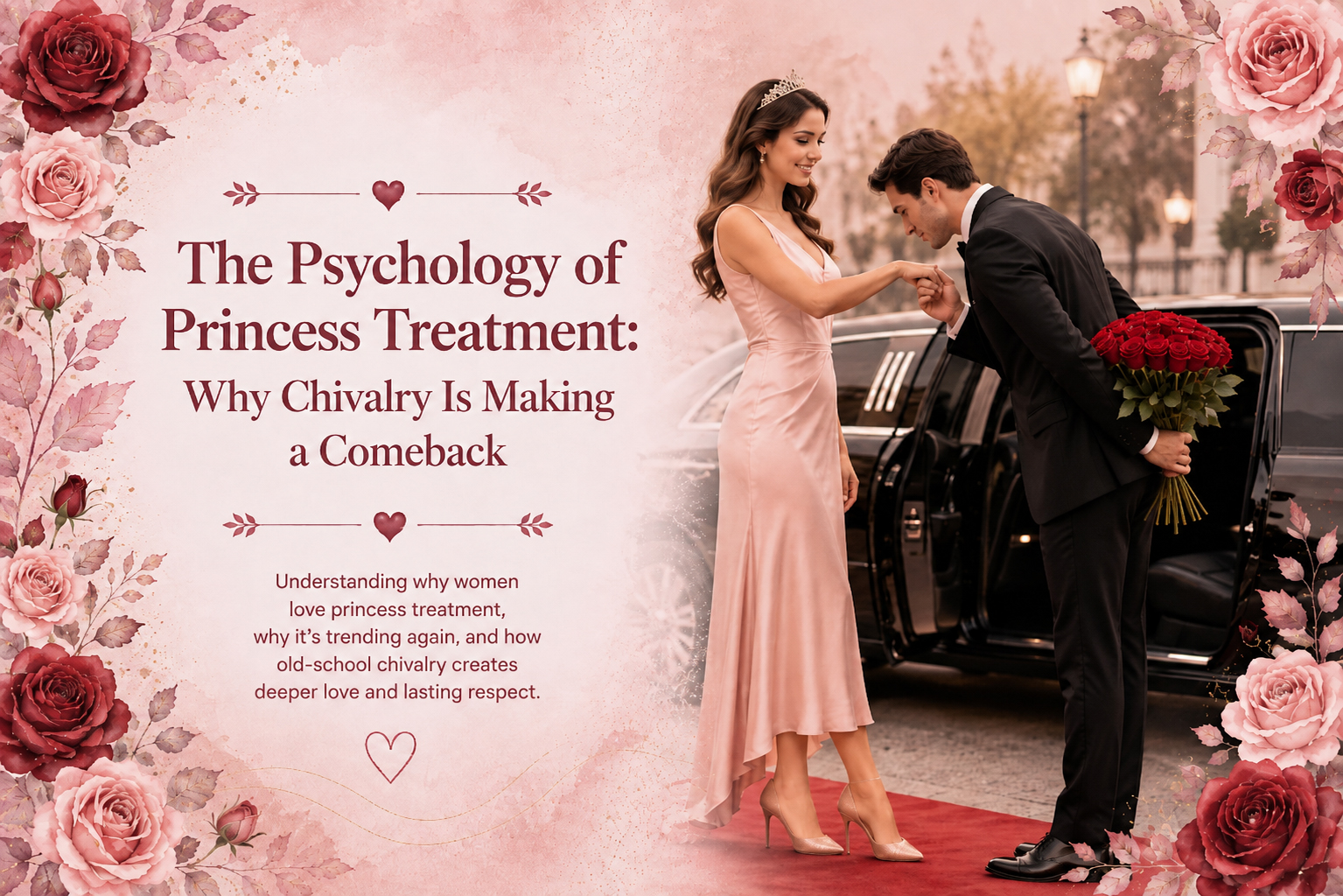
The Psychology of Princess Treatment: Why Chivalry Is Making a Comeback
At first glance, “princess treatment” can sound frivolous. The phrase brings to mind flowers, expensive dinners, opened doors, and a man who insists that the woman beside him should not have to worry about the bill.
Online, it is sometimes dismissed as entitlement. Women who want it are accused of being spoiled, materialistic, or unwilling to contribute to a relationship. Yet the popularity of the phrase is not really about pretending to be royalty. For most women who use it, princess treatment describes a relationship in which a man is proactive, generous, and attentive. He plans rather than waiting to be instructed. He notices rather than needing to be managed. He gives without immediately asking what he will receive in return.
In other words, princess treatment is largely old fashioned chivalry under a new, social media friendly name. And as this article explores, the resistance to it often comes from a transactional mindset, the idea that spending unevenly must mean someone is keeping score, when in practice it is usually the opposite: a strict 50/50 ledger is the transactional approach, while princess treatment tends to reflect a couple who has stopped counting.
Underneath the gestures is often an unspoken belief: that taking this particular woman out is not an obligation to be met but a privilege, and that her company is an honour rather than something to be taken for granted.
What Does Princess Treatment Actually Mean?
Princess treatment does not have one universal definition. For one woman, it may mean that her partner plans the date, makes the reservation, and pays for dinner. For another, it may mean carrying the heavy bags, remembering important details, or surprising her with something thoughtful.
A viral 2025 discussion brought the phrase into wider public attention when a content creator’s description of her husband’s traditional date night behaviour received millions of views. Although the more extreme elements attracted criticism, many women responded to the underlying idea: they wanted to feel considered and relieved of always having to lead.
The healthiest definition is not that a woman does nothing while a man does everything. It is this:
A pattern of intentional generosity through which a woman feels cherished rather than tolerated, pursued rather than managed, and safe enough to receive care without being made to feel indebted for it.
The flowers and the restaurant bill are symbols. The deeper message is that he thought about her, anticipated her needs, and finds that making her happy feels good to him. Beneath that message often sits something even more fundamental: the sense that he considers it a treasured opportunity to spend an evening with her at all.
Why Many Women Love Princess Treatment
Relationship research consistently identifies perceived partner responsiveness as one of the foundations of intimacy. A responsive partner is experienced as understanding, validating, and attentive.
Psychologist Gurit Birnbaum and colleagues found that perceived partner responsiveness was associated with increased sexual desire, with the effect particularly strong among women. Feeling that a partner truly understood and valued them helped participants feel special and made closeness with that partner more desirable.
This helps explain why princess treatment can feel more meaningful than its individual gestures appear. A man opening a door is not inherently life changing. A dinner bill is only a dinner bill. But when these gestures form part of a consistent pattern, they communicate investment. The woman does not have to wonder whether he is interested, or whether every act of generosity will later appear on an emotional invoice.
Princess treatment can offer several psychological experiences at once:
- Responsiveness: He notices what makes her feel comfortable and valued.
- Intentionality: He plans rather than offering whatever is easiest at the last minute.
- Emotional safety: She does not have to negotiate for every small act of consideration.
- Relief: She can step out of the managerial role and simply enjoy being cared for.
This does not mean women are incapable of planning, paying, or taking care of themselves. Often, the women most drawn to princess treatment are extremely capable. The appeal lies precisely in not having to demonstrate that capability every minute of every day. Being capable of carrying everything herself does not mean it stops feeling loving when a partner steps in and carries it for her.
There is also something worth naming about how this dynamic tends to land emotionally. When a woman senses that her partner treats time with her as a privilege rather than a given, she often does not need to hold herself so carefully at arm's length. She can soften. Many women describe feeling more openly affectionate, more admiring, and more visibly doting toward a partner who has made it clear, through his consistency and effort, that being with her feels like an honour to him rather than a routine.
Why Princess Treatment Is Resurging Now
The phrase may be new, but the longing behind it is not. What has changed is the dating environment in which women are expressing it.
Pew Research Center found that 66% of women under 50 who had used a dating platform reported experiencing at least one of several unwanted behaviours, including unwanted sexual content, continued contact after expressing disinterest, or offensive name calling. Women were also substantially more likely than men to report feeling overwhelmed by the volume of messages they received.
Against that backdrop, deliberate courtship can feel almost radical. A man who makes a clear plan, confirms the time, pays without creating an awkward negotiation, and checks that his date arrived home safely is communicating something very different from the uncertainty many women encounter online.
A few features of modern dating help explain the resurgence:
- Dating has become low investment. People can swipe, match, and disappear with very little social cost, so visible effort stands out as a sign of serious interest.
- Compulsory independence is exhausting. There is a difference between knowing you can care for yourself and being expected to accept a relationship where nobody ever cares for you.
- Traditional gestures create clarity. Princess treatment offers a recognizable script after relationships defined by ambiguity and constant negotiation.
Social media did not invent the appeal of a thoughtful partner. It simply bundled flowers, planning, and generosity into a phrase that women could easily discuss.
Princess Treatment Is Old School Chivalry Rebranded
Traditional chivalry included a man courting intentionally, offering protection, and demonstrating that he was prepared to invest before expecting access to a woman’s time or affection. Princess treatment carries many of the same behaviours: a proper date rather than a vague plan to hang out, arriving on time, paying graciously, and checking that she arrived home safely.
The important distinction is between chivalry and control. Research on benevolent sexism shows that apparently positive beliefs about protecting women can become harmful when they assume a woman is weak, less competent, or obligated to stay within a restrictive role. Protective behaviour is not truly loving when it is used to limit a woman’s choices or demand submission in return.
Healthy princess treatment says: “I know you are capable, and I still enjoy caring for you.” Unhealthy paternalism says: “Because I care for you, I should control you.” One expands a woman’s freedom. The other reduces it.
The best parts of chivalry can be preserved without reviving the belief that a woman should be quiet or dependent. It is possible to bring back generosity without bringing back inequality.
What Princess Treatment Looks Like in a Healthy Relationship
For couples who prefer traditional courtship, treating a woman well is not primarily about extravagance. It is about consistent behaviour that communicates care, investment, and emotional security. A thoughtful man does not wait for a woman to manage every detail of the relationship. He makes plans, follows through, and pays for dates graciously when that is the dynamic both people value, rather than turning dinner into a negotiation.
Some common examples include:
- Planning the date rather than asking her to decide everything
- Confirming arrangements and following through on them
- Paying graciously, without treating it as a favour owed
- Giving flowers or small gifts because it brings him joy, not because affection must be purchased
- Checking in after a date to make sure she got home safely
- Staying emotionally present and affectionate after intimacy, rather than growing distant or casual
That last point matters more than it might seem. Sex can create vulnerability and heightened emotional sensitivity, particularly early in a relationship. A man who pulls away right after can leave a woman feeling used or confused. Healthy reassurance does not require an elaborate speech. It can look as simple as attentive communication the next day, a chivalrous plan for a romantic next date, a thoughtful gesture such as sending roses, or anything that says he values what was shared and is not disappearing now that he has it.
What matters most is congruence. His words, effort, and level of commitment should tell the same story, rather than pursuing her intensely until intimacy occurs and then pulling back. It also helps to stay curious about what makes that particular woman feel loved. One woman may treasure roses and elegant dinners. Another may value a carefully planned picnic, practical help during a stressful week, or a handwritten note. The same woman may need different things at different times to feel loved. The goal is not a fixed script, but consistent attentiveness. Done well, princess treatment should leave a woman feeling safer and more certain of his intentions, not more anxious about where she stands.
Why “What Do You Bring to the Table?” Feels So Repellent
There is nothing wrong with wanting a reciprocal relationship. Yet many women feel an immediate aversion when a man responds to their standards by asking what they bring to the table. The problem is partly the timing and partly the mindset.
Psychologists Margaret Clark and Judson Mills distinguish between communal relationships and exchange relationships. In an exchange relationship, people carefully track what they give and expect a comparable benefit in return, which is appropriate in many business contexts. In a communal relationship, people respond to one another’s needs because they care, trusting that the relationship as a whole will contain mutual concern rather than demanding immediate repayment for each gesture.
Asking what a woman brings to the table frames intimacy as an exchange relationship before intimacy has even formed. Romance is not a business deal. This is the heart of what makes a relationship transactional: not who happens to spend more in a given month, but whether every gesture is being privately tallied and expected back in kind. A man who pays for dinner because it makes him happy to do so is not being transactional. A man who pays for dinner while mentally logging it as a debit against future favours is. The dollar amount looks identical from the outside. The philosophy underneath it does not.
A woman may bring warmth, affection, companionship, emotional insight, encouragement, and the creation of a home that feels emotionally alive. She may support a partner’s ambitions, remember the relationships that matter to him, and provide the emotional safety that allows him to recover from the demands of work. These contributions are real even when nobody sends an invoice for them, and when a woman’s contributions are ignored and she is asked to contribute financially to his ledger, she may begin creating her own invoice for what she has already contributed and feels was undervalued. That does not create a communal dynamic that nurtures both partners. It is important for a woman’s contributions to feel valued, even if they are not concretely monetary.
The Hidden Costs Women Already Carry
A rigidly symmetrical definition of fairness can overlook how asymmetrical heterosexual life often remains. Statistics Canada’s Time Use Survey found that women spent an average of 3.7 hours per day on unpaid work, compared with 2.6 hours for men, while also receiving less leisure time.
Women also frequently carry costs that appear before a couple ever shares a home:
- Greater safety planning around dates, transportation, and sexual encounters
- Higher exposure to sexualized harassment in online dating
- Reproductive and contraceptive burdens
- Gendered expectations involving grooming, clothing, and appearance
- Greater risk of being expected to organize the couple’s emotional and social life
- The possibility of pregnancy, childbirth, career interruption, and disproportionate caregiving
This does not mean that every woman experiences every cost, or that men have no burdens. It means that a simple “I paid $100, so what exactly are you giving me?” calculation begins from an incomplete ledger, and treating that ledger as the whole picture of fairness is its own kind of transactional thinking.
A woman may reject that question not because she plans to contribute nothing, but because the man asking it appears unable to recognize forms of contribution that men have historically received without naming, pricing, or even noticing them.
The Hidden Benefits Men Often Receive From Partnership
Research has repeatedly found associations between marriage and better health outcomes, particularly for men. A large systematic review and meta-analysis involving millions of participants found that being unmarried was associated with mortality risk for both sexes, but that the relative disadvantage was generally greater for men.
Married men have also frequently been observed to earn more than unmarried men, a pattern known as the male marriage wage premium, although the causal explanation remains disputed. The careful conclusion is not that every man owes his success to a woman. It is that men often receive meaningful relational, social, and practical benefits from partnership that are easy to overlook because they do not arrive as a direct cash transfer. A woman’s contribution is not absent merely because it is difficult to quantify.
Masculine and Feminine Energy: Science, Symbolism, and Polarity
“Masculine energy” and “feminine energy” are popular relationship terms, not formal psychological diagnoses, and they should not be treated as biological laws dictating what every man or woman must want. Social role theory proposes that many observed gender differences develop through a mixture of physical realities, cultural expectations, and the roles men and women are encouraged to occupy.
Cross-cultural mate preference research has nevertheless found average differences in what heterosexual men and women prioritize. In a landmark study across 37 samples, women placed greater average importance than men on a prospective partner’s ability to acquire resources, although social role researchers note that these preferences can shift as women’s economic opportunities change.
For some couples, the provider and receiver dynamic feels deeply satisfying. The man experiences purpose through protecting and providing. The woman experiences trust and pleasure through receiving his effort and creating warmth in return. Receiving is not the same as passivity. The arrangement becomes unhealthy only when either person is forced into it or denied the freedom to develop other parts of themselves.
Part of what makes this polarity work, when it works, is the underlying attitude a man brings to it. A man who treats dating her as a privilege rather than a formality tends to draw out a woman's warmth rather than her guardedness. She is less likely to need to prove her worth or protect herself from disappointment, and more likely to let herself become admiring, affectionate, and doting in return. That shift is not about becoming less capable. It is about feeling safe enough to be openly fond of someone who has already shown, through his behaviour, that he does not take her for granted.
Princess Treatment Is Not About Keeping Score
Princess treatment does not mean a woman never gives. It means that love is not reduced to immediate repayment.
A generous man may pay for dinner because taking his partner somewhere beautiful makes him happy. A loving woman may bring tenderness, loyalty, or a thoughtful experience of her own. Neither contribution has to be identical to be valuable.
Equity asks whether both people are cared for and whether the relationship supports both of their flourishing. Rigid equality asks whether every expense and gesture has been divided into matching halves. Across a lifetime, relationships are almost never perfectly equal at every moment. One partner may earn more while the other provides care. One may carry the couple through illness, grief, or unemployment. A healthy partnership is not one in which nobody ever gives more. It is one in which generosity can move safely in both directions without being tracked like a running tab.
For women who value traditional courtship, a man’s willingness to provide is not proof that she is incapable. It is evidence that his instinct in love is to move toward generosity rather than toward the smallest contribution he can defend as technically fair, which is itself the more transactional posture even when it looks like the more equal one on paper.
That same instinct tends to show up when something goes wrong, too. A man who leans toward generosity rather than a ledger is usually also the one who can offer a real apology rather than a defensive explanation when he has hurt his partner. Our article on effective apologies and reconciliation goes into what actually makes an apology land, which matters just as much to a generous relationship as the giving does.
What She Is Really Asking For
Princess treatment is not truly about princesses. It is about the longing to feel precious to someone.
For many women, the most attractive part is not the dinner or the flowers. It is the experience of being with a man whose first question is not how little he can contribute while still calling it equal. It is being with someone who thinks about how he can make her life more beautiful, who treats her company as a privilege rather than a given, and who trusts that a woman who feels safe and generously loved will bring her own form of abundance to the relationship, not because she was forced to prove her value at the door, but because love naturally makes her want to give in return.
Pacific Maple Psych Centre offers individual and couples therapy in Vancouver for relationship dynamics, communication, and the beliefs about giving and receiving that couples bring into their partnerships. If this article sounds familiar, you do not have to work through it alone.
Book Your Session TodayCommon Questions About Princess Treatment
Is princess treatment materialistic?
It can become materialistic when affection is measured exclusively by spending. More often, the appeal is responsiveness and effort. Princess treatment can also look like receiving the experience of a man planning the whole evening, driving, opening the car door, and making sure she gets home safely. The spending is incidental to the pattern of being looked after.
Is wanting a man to pay anti-feminist?
Not necessarily. Feminism protects a woman’s ability to choose her relationships and negotiate the arrangement that suits her values. A woman can support equal legal and professional opportunities while personally preferring traditional romantic generosity.
Does princess treatment mean the woman contributes nothing?
No. It means contribution is not defined solely by identical financial spending. She may contribute emotionally, socially, domestically, or financially. The couple should discuss expectations honestly, but they do not have to contribute in precisely the same way to be equally invested.
How can couples distinguish chivalry from control?
Chivalry expands comfort and choice. Control restricts them. A healthy partner can offer leadership without punishing disagreement, provide without creating debt, and protect without assuming incompetence.
Why does feeling like a privilege rather than a given change how a woman shows up in the relationship?
When a man treats a woman as rare and special, and views dating her as a privilege rather than something ordinary, she often does not need to stay as guarded. Feeling treasured, rather than merely existing in a man's presence, tends to let a woman soften, becoming more openly affectionate, admiring, and doting toward a partner who has already shown her, through his effort, that he does not take her for granted.
Questions about money, generosity, and fairness rarely stay about money for long. If disagreements about spending, roles, or who gives more have become a recurring source of tension in your relationship, working with a therapist can help you find language for what is really going on underneath. Pacific Maple Psych Centre offers individual and couples therapy in Vancouver.
Book a SessionSources
- Birnbaum, G. E., Reis, H. T., Mizrahi, M., Kanat-Maymon, Y., Sass, O., & Granovski-Milner, C. (2016). Intimately connected: The importance of partner responsiveness for experiencing sexual desire. Journal of Personality and Social Psychology, 111(4), 530–546.
- Buss, D. M. (1989). Sex differences in human mate preferences: Evolutionary hypotheses tested in 37 cultures. Behavioral and Brain Sciences, 12(1), 1–49.
- Clark, M. S., & Mills, J. R. (2012). A theory of communal and exchange relationships. In P. A. M. Van Lange, A. W. Kruglanski, & E. T. Higgins (Eds.), Handbook of theories of social psychology (Vol. 2, pp. 232–250). SAGE Publications.
- Eagly, A. H., Wood, W., & Diekman, A. B. (2000). Social role theory of sex differences and similarities: A current appraisal. In T. Eckes & H. M. Trautner (Eds.), The developmental social psychology of gender (pp. 123–174). Lawrence Erlbaum Associates.
- Killewald, A., & Lundberg, I. (2017). New evidence against a causal marriage wage premium. Demography, 54(3), 1007–1028.
- McClain, C., & Gelles-Watnick, R. (2023). From looking for love to swiping the field: Online dating in the U.S. Pew Research Center.
- Oswald, D. L., Baalbaki, M., & Kirkman, M. S. (2019). Experiences with benevolent sexism: Scale development and associations with women’s well-being. Sex Roles, 80(5–6), 362–380.
- Statistics Canada. (2025). Quality of life indicator: Time use. Government of Canada.
- Wang, Y., Jiao, Y., Nie, J., O’Neil, A., Huang, W., Zhang, L., Han, J., Liu, H., Zhu, Y., Yu, C., & Woodward, M. (2020). Sex differences in the association between marital status and the risk of cardiovascular, cancer, and all-cause mortality: A systematic review and meta-analysis of 7,881,040 individuals. Global Health Research and Policy, 5, Article 4.
- Wilshere, M. (2025, July 5). Woman who doesn’t open doors or order her own food speaks out about controversial “princess treatment” content. People.