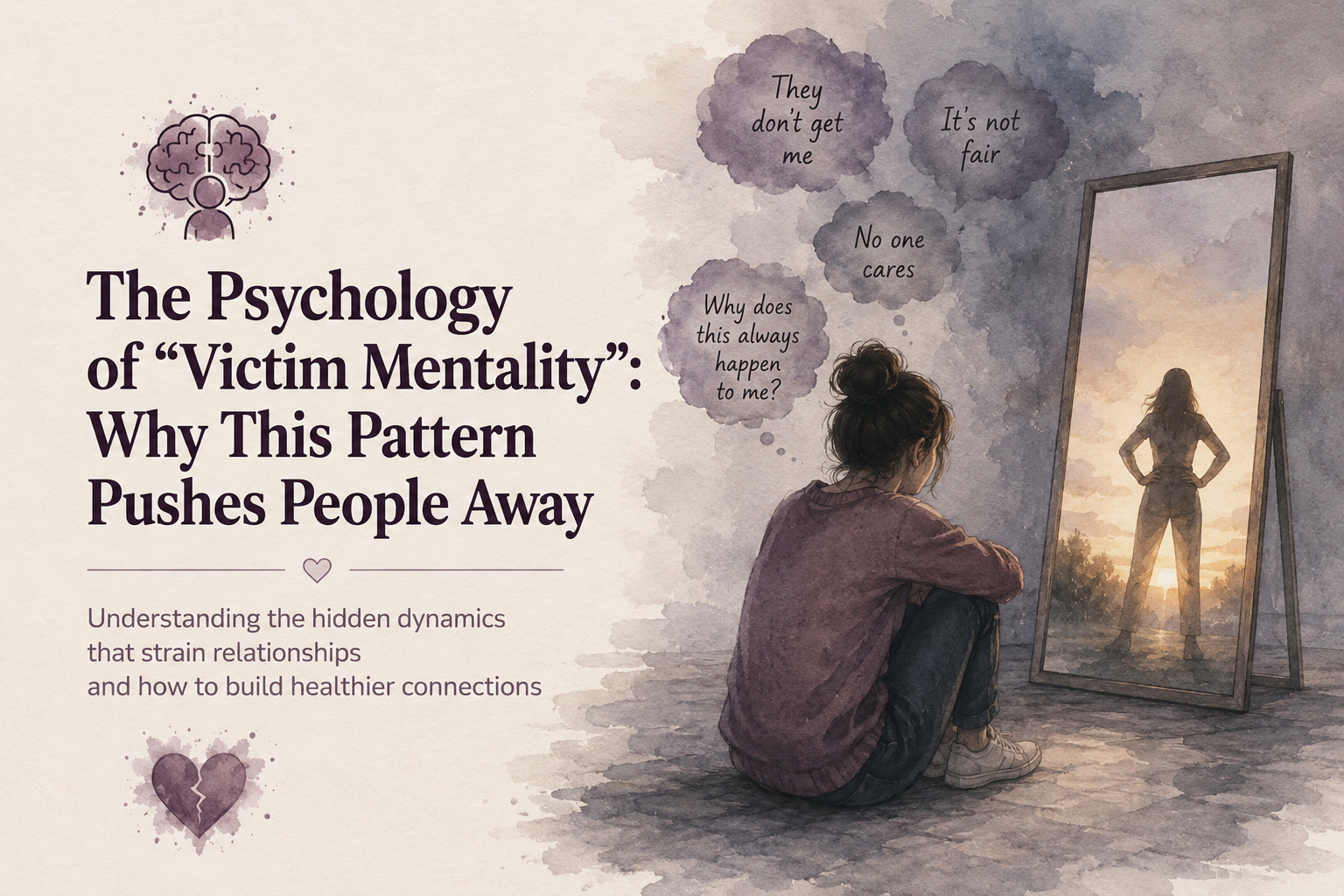
The Psychology of “Victim Mentality”: Why This Pattern Pushes People Away
Most people can think of someone who turns nearly every situation into proof that they have been wronged. A friend who reframes any disagreement as betrayal. A coworker who hears routine feedback as a personal attack. A family member who, no matter how a conflict started, ends up the one who was hurt.
At first, the instinct is to offer support. Over time, something else creeps in: a quiet urge to say less, share less, and spend less time around that person. Many people feel guilty about this instinct, since the person in question often has been through real difficulty. But the discomfort is common enough that psychologists have spent the last several years studying it directly, and the explanation turns out to be more specific and less judgmental than "people are just unsympathetic."
An important distinction before going further: This article is not about people processing real trauma, grief, abuse, or discrimination. Naming harm when it happens is healthy, necessary, and often the first step toward healing. What researchers are describing is a different, narrower pattern: a generalized, persistent sense of being victimized across many unrelated situations, regardless of what actually happened. The difference matters, and we will come back to it.
What Researchers Mean by a “Victim Identity”
In 2020, psychologist Rahav Gabay and colleagues at Tel Aviv University introduced a personality construct called the Tendency for Interpersonal Victimhood (TIV): an enduring feeling of being a victim that generalizes across many different relationships, rather than arising from one specific event. Their research, published in Personality and Individual Differences, identified four components that tend to travel together:
- A constant need for recognition. A strong drive to have one's suffering acknowledged, often experienced as never feeling sufficiently validated even after others have apologized or made an effort to understand.
- Moral elitism. A sense of being more moral, more considerate, or more justified than the people perceived as having caused harm.
- Low empathy for others' pain. Difficulty extending the same compassion to other people's hurt that is expected for one's own, particularly when that hurt was caused by the same person.
- Rumination. A tendency to dwell on perceived offenses long after they have occurred, replaying them rather than processing and moving past them.
Gabay's team also found this tendency correlates with specific thinking patterns: people higher in TIV are more likely to interpret ambiguous situations as hostile, to attribute negative intent to others' actions, and to remember past conflicts as more severe than they were recorded at the time. It isn't just a way of talking about oneself. It shapes how a person actually perceives and recalls events.
This Is Not the Same as Being a Real Victim
This is worth stating plainly, because the line gets blurred often, sometimes deliberately, by people trying to dismiss legitimate grievances.
Someone who has survived abuse, assault, discrimination, or a serious betrayal and talks about that experience is not displaying a "victim identity" in the clinical sense. They are describing something that happened to them. Acknowledging real harm is not a personality flaw, and the existence of this research is not a license to wave away someone's genuine pain by labeling it.
What Gabay and colleagues describe is a pattern that generalizes far beyond any single event: a lens that gets applied to interactions with a partner who forgot to text back, a barista who seemed short, a coworker who disagreed in a meeting. The research is also clear that this tendency is linked to anxious attachment style: people who grew up uncertain whether their emotional needs would be met often carry a heightened alertness to being hurt or dismissed again. Seen this way, it's less a character flaw and more a nervous system that learned, early and for understandable reasons, to expect harm.
Why People Pull Away: A Psychological Explanation
So why does this particular pattern, as opposed to ordinary venting or talking about a hard week, tend to wear relationships down? A few converging strands of research point to a consistent explanation.
1. Relationships run on reciprocity, and this pattern breaks it
Social exchange theory, one of the oldest frameworks in relationship psychology, holds that close relationships depend on a rough balance of give and take: emotional support flows both ways over time. The lack-of-empathy component Gabay's team identified means that support tends to flow in one direction only. People are generally willing to show up for someone in pain. What erodes goodwill is the felt sense that support is expected but never returned, especially when the same person seems unmoved by others' struggles.
2. The moral framing raises the emotional stakes of every disagreement
When a person frames themselves as not just hurt but morally superior to whoever hurt them, ordinary friction stops being negotiable. Disagreeing, setting a boundary, or even gently offering a different perspective starts to feel like proof that you, too, are now one of the people who has wronged them. Friends and partners often describe walking on eggshells, not because they don't care, but because there's no room to have a normal human disagreement without it becoming evidence of betrayal.
3. Research on “virtuous victim signaling” adds a more complicated layer
A separate line of research, led by Ekin Ok and colleagues at the University of British Columbia and published in the Journal of Personality and Social Psychology, looked at what happens when claims of victimhood are paired with displays of virtue. Their studies found this combination is unusually effective at prompting others to offer help, sympathy, or resources. People higher in Dark Triad traits (narcissism, Machiavellianism, psychopathy) used this combination more frequently than others. Related work on moral grandstanding notes that people widely perceived as victims tend to be "hyper-moralized": seen as automatically deserving of support, while whoever is cast as having harmed them is seen as a fair target for criticism.
This research matters, but it deserves a careful caveat: it describes a minority pattern, not the typical person who struggles with this. Most people who get stuck in a victim identity aren't manipulating anyone. They're anxious, hurting, and repeating a script that once protected them. But this research helps explain a specific, gut-level wariness many people develop: a sense that sympathy is being used as currency rather than received as care. Once people sense that dynamic, even unconsciously, they tend to start protecting themselves by withdrawing.
4. Negativity bias means the cost is felt before the cause is understood
Humans are wired to register negative or threatening information more strongly than positive information. A relationship that repeatedly requires managing someone else's perceived injuries, without the relief of resolution, registers as draining well before anyone consciously diagnoses why. This is the same mechanism behind compassion fatigue in caregiving professions: empathy is not an infinite resource, and chronic, unreciprocated demands on it lead people to instinctively conserve it, often by creating distance.
Taken together, these findings suggest the dislike isn't really about the word "victim" at all. It's a reaction to an imbalance: one person's pain consistently outweighing the relationship's capacity to also hold the other person's needs, perspective, and humanity.
Common Questions About Victim Mentality
What does “victim mentality” mean in psychology?
It refers to a generalized, recurring tendency to perceive oneself as wronged across many situations and relationships, rather than a description of someone who experienced a specific harmful event. Researchers call the formal construct the Tendency for Interpersonal Victimhood, and it includes four parts: needing recognition for suffering, feeling morally superior to those perceived as causing harm, having difficulty empathizing with others' pain, and ruminating on past hurts.
Is having a victim mentality the same as being a real victim of something?
No. Experiencing real harm (abuse, discrimination, betrayal, loss) and talking about it is healthy and important. A victim identity, as researchers define it, is a broader pattern that applies a victimized lens to situations regardless of what actually happened, often without resolution even when the original issue is addressed.
Why do people get tired of being around someone who always feels wronged?
Relationships rely on a rough balance of emotional give and take. When one person consistently needs their pain acknowledged but struggles to extend the same empathy back, the relationship starts to feel one-sided. Over time, that imbalance, not the person's pain itself, is usually what causes others to withdraw.
Is a victim mentality a personality disorder?
No. The Tendency for Interpersonal Victimhood is studied as a personality trait that exists on a spectrum in the general population, not a diagnosable disorder. It is often connected to anxious attachment patterns formed earlier in life, rather than to any specific clinical condition.
Recognizing this pattern in yourself can be the first step toward changing it. At Pacific Maple Psych Centre, our therapists offer individual therapy in Vancouver to help you build a more secure sense of self-worth and break old protective habits that may be pushing people away.
Book a SessionCan someone change this pattern?
Yes. Because the pattern is tied to attachment style and learned ways of interpreting ambiguous situations, it responds well to therapeutic approaches that build a more secure sense of self-worth: one that doesn't depend on having one's suffering constantly recognized by others. Many people find real relief once they understand the pattern as a protective habit rather than a fixed identity.
How is this different from someone processing trauma or venting about a hard day?
Processing trauma and ordinary venting are bounded: they relate to something specific, they allow space for the listener's perspective, and there is usually some movement toward resolution over time. A generalized victim identity tends to apply to a much wider range of situations, resists outside perspective, and rarely arrives at resolution, even when others go out of their way to repair the relationship.
Therapy for Victim Mentality and Relationship Patterns in Vancouver
This pattern is rarely about a person being unkind at their core. More often, it reflects an old, understandable strategy: one shaped by attachment history, past invalidation, or relationships where being hurt was the only thing that reliably got noticed. The pattern persists because, at some point, it worked.
At Pacific Maple Psych Centre, our therapists work with people on both sides of this dynamic. Some clients recognize the pattern in themselves and want to build a more secure sense of self-worth that doesn't hinge on others constantly validating their pain. Others are navigating a relationship with someone who fits this description and want support setting boundaries without becoming defensive or losing their own empathy in the process. Both are common, both are workable, and neither requires assigning blame to get unstuck.
A Final Thought
It's tempting to read research like this as a way to dismiss someone: to attach a label and stop listening. That would miss the point entirely. The goal of understanding a victim identity isn't to decide who deserves sympathy and who doesn't. It's to notice when a relationship has lost its balance, and to understand that the imbalance usually comes from an old wound, not a character defect.
The people who eventually break this pattern aren't the ones who get told to stop feeling hurt. They're the ones who, often with support, learn that their worth was never actually in question, which means they no longer need every interaction to prove it.
Pacific Maple Psych Centre offers individual and couples therapy in Vancouver for people on both sides of this dynamic. Whether you recognize the pattern in yourself or are navigating a relationship where the balance has been lost, we are ready to help.
Book Your Session TodaySources
- Gabay, R., Hameiri, B., Rubel-Lifschitz, T., & Nadler, A. (2020). The Tendency for Interpersonal Victimhood: The Personality Construct and Its Consequences. Personality and Individual Differences, 165, 110134.
- Gabay, R., Hameiri, B., Rubel-Lifschitz, T., & Nadler, A. (2020). The Tendency to Feel Victimized in Interpersonal and Intergroup Relationships. In J. R. Vollhardt (Ed.), The Social Psychology of Collective Victimhood. Oxford University Press.
- Ok, E., Qian, Y., Strejcek, B., & Aquino, K. (2020). Signaling Virtuous Victimhood as Indicators of Dark Triad Personalities. Journal of Personality and Social Psychology.