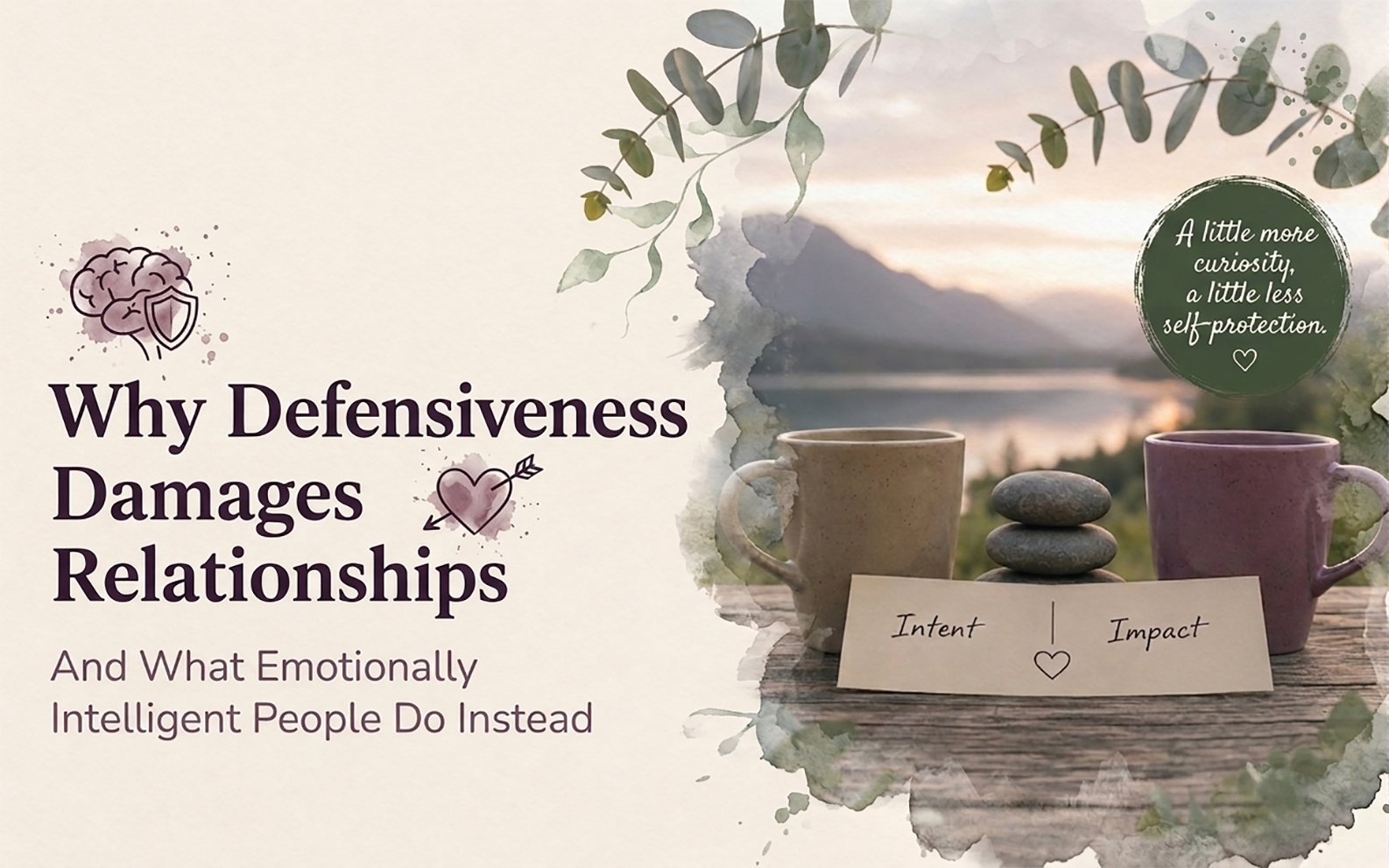
Why Defensiveness Damages Relationships (And What Emotionally Intelligent People Do Instead)
If you have ever brought up a concern to a partner, friend, family member, or colleague, you have probably experienced a frustrating phenomenon.
You explain that something hurt your feelings.
And instead of discussing what happened, the conversation immediately shifts into a debate about whether the other person is a good person.
"I didn't mean it that way."
"That's not what I intended."
"You're misunderstanding me."
"I would never do that."
Before long, the original issue has disappeared entirely. The conversation is no longer about the impact of the behaviour. It is about protecting someone's self-image.
Psychologists call this defensiveness.
And while it is one of the most common communication habits people engage in, it is also one of the most damaging.
What Is Defensiveness?
Defensiveness is a psychological reaction that occurs when a person perceives feedback, criticism, disappointment, or conflict as a threat to their identity.
Most people like to think of themselves as kind, caring, reasonable, and well-intentioned. When someone points out that our actions hurt them, it can create an uncomfortable internal conflict.
If I am a good person, and my actions hurt someone, what does that mean?
For many people, the immediate instinct is to resolve this discomfort by defending their intentions.
"I didn't mean to hurt you."
While that statement may be true, it often misses the point entirely.
The person who was hurt already knows you probably did not intend harm. What they are trying to discuss is the impact.
Why Good People Become Defensive
One of the most misunderstood aspects of defensiveness is that it is not usually a sign of malice.
In fact, defensiveness often comes from the opposite place.
People become defensive because they care deeply about being seen as good.
The problem is that their desire to protect that identity becomes stronger than their desire to understand the other person's experience.
The conversation shifts from:
"I want to understand why you're hurt."
To:
"I need you to understand that I'm not a bad person."
Ironically, this usually makes the hurt person feel even less understood.
When someone is upset, they are rarely asking you to prove that you are good. They are asking you to show that you care about what happened to them.
The Difference Between Intent and Impact
One of the most important concepts in emotionally intelligent communication is understanding the difference between intention and impact.
Intent refers to what you meant to do.
Impact refers to what the other person experienced.
These are not always the same thing.
A joke may be intended as playful and still land as hurtful.
A comment may be intended as helpful and still come across as critical.
A forgotten text message may be entirely accidental and still leave someone feeling unimportant.
Acknowledging impact does not require agreeing that you intended harm.
It simply requires acknowledging reality.
Someone was affected by something you did.
That fact exists whether the outcome was intentional or not.
What Emotionally Intelligent People Understand
Emotionally intelligent people have often learned something that many others have not.
They understand that making a mistake does not automatically make them a bad person.
This sounds simple, but it is actually profound.
When people feel secure in their own character, they do not have to spend all their energy defending it.
Instead, they can stay present with the discomfort.
They can think:
"I know I am generally a good person."
"And because I know that, I don't need to prove it right now."
"I can focus on understanding why this person was hurt."
Paradoxically, people often appear more trustworthy when they stop trying so hard to convince others that they are trustworthy.
The ability to tolerate feedback without immediately defending oneself is often a sign of emotional maturity, self-awareness, and psychological security.
How to Apologize for Impact
One of the most common questions therapists hear is:
"How do I apologize when I didn't mean to hurt someone?"
The answer is surprisingly simple.
Separate impact from intent.
A less effective apology might sound like:
"I'm sorry you took it that way."
Or:
"I'm sorry, but that wasn't my intention."
An effective apology sounds more like:
"I can see that what I said hurt you."
"That wasn't my intention, but I understand that it landed badly."
"I'm sorry for the impact it had."
Notice what is happening here.
The person is not admitting malicious intent.
They are not accepting blame for things they did not do.
They are simply acknowledging the reality of the other person's experience.
That acknowledgment often creates more connection than a dozen explanations ever could.
Common Questions About Defensiveness and Apologizing
Why do people get defensive when criticized?
Defensiveness is often an unconscious attempt to protect self-esteem. Feedback can feel threatening because people interpret criticism of their behaviour as criticism of their character. Learning to separate behaviour from identity is a key component of emotional growth.
Is defensiveness a sign of insecurity?
Often, yes. People who feel secure in themselves are generally more capable of hearing feedback without immediately needing to justify, explain, or defend themselves. Defensiveness frequently emerges when someone feels their self-image is under threat.
Can a relationship survive chronic defensiveness?
Relationships can recover from defensiveness, but only if both people are willing to recognize the pattern. Persistent defensiveness often leaves partners feeling unheard, invalidated, and emotionally disconnected. Over time, this can significantly erode trust and intimacy.
Why does my partner always explain instead of apologize?
Many people mistakenly believe that explaining their intentions is the same as repairing hurt. While explanations may provide context, they rarely address the emotional impact. Most people feel understood when their experience is acknowledged, not when it is debated.
Stuck in a cycle of explaining instead of connecting? Pacific Maple Psych Centre offers couples therapy in Vancouver to help you and your partner break defensive patterns and communicate in a way that actually repairs hurt.
Book a SessionHow can therapy help with defensiveness?
Therapy can help individuals identify the underlying fears, beliefs, and emotional reactions that drive defensive behaviour. Many people discover that defensiveness is linked to shame, perfectionism, childhood experiences, conflict avoidance, or fears of rejection. Learning healthier ways to tolerate feedback can dramatically improve communication and relationships.
Therapy for Communication and Relationship Issues in Vancouver
Many relationship conflicts are not caused by bad intentions.
They are caused by two people becoming trapped in cycles of defensiveness, misunderstanding, and emotional reactivity.
At Pacific Maple Psych Centre, our therapists work with individuals and couples to develop emotional intelligence, improve communication skills, navigate conflict more effectively, and build stronger relationships.
Whether you find yourself becoming defensive when receiving feedback, struggling to get through to a loved one, or feeling repeatedly unheard in your relationships, therapy can provide practical tools and deeper insight into the patterns keeping those conversations stuck.
A Final Thought
One of the strongest indicators of emotional intelligence is not the absence of mistakes.
It is the ability to hear that you made one without needing to protect your ego first.
The most effective communicators understand something important:
Being a good person and making a mistake are not mutually exclusive.
You can be kind and still hurt someone.
You can have good intentions and still create a negative impact.
You can acknowledge that impact without surrendering your self-worth.
In fact, the more secure you are in who you are, the less you need to defend it.
And when you stop defending your identity, you become far more capable of protecting your relationships.
Pacific Maple Psych Centre offers individual and couples therapy in Vancouver to help you build the emotional intelligence and communication skills that protect your relationships. If you are ready to break the cycle of defensiveness, we are ready to help.
Book Your Session Today