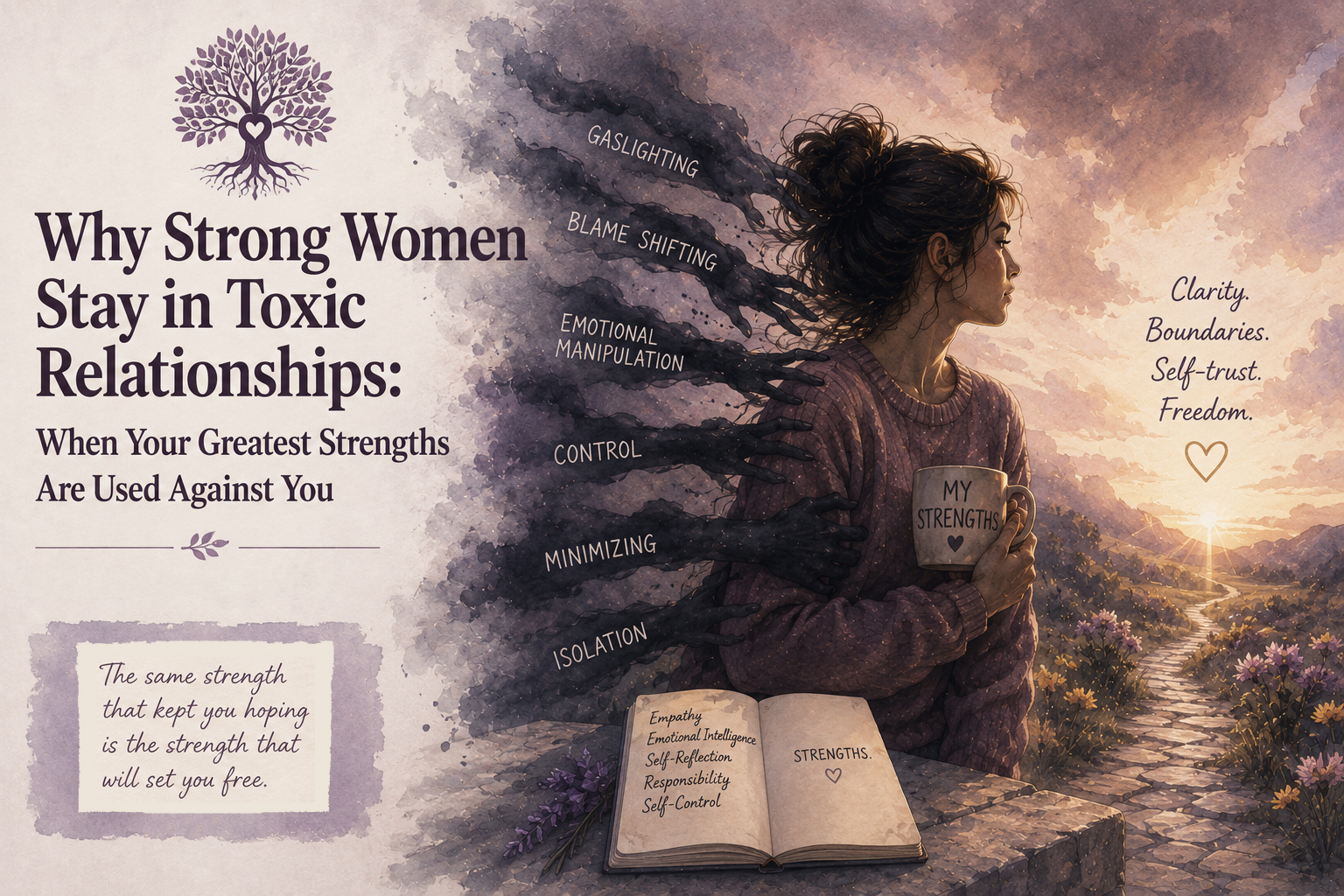
Why Strong Women Stay in Toxic Relationships: When Your Greatest Strengths Are Used Against You
When people learn that a capable, intelligent woman has stayed in a toxic relationship for years, the question that surfaces most quickly is some version of: why didn’t she just leave? The question itself reveals the misunderstanding. It assumes that staying requires an explanation, and that the explanation must be some kind of deficit: a lack of self-worth, a failure of perception, a weakness of character.
What the research actually shows is almost the opposite. The traits most strongly associated with staying in a toxic relationship are not weaknesses. They are the same qualities that make someone a deeply loving, emotionally attuned, and reliable partner: empathy, self-reflection, emotional intelligence, a strong sense of responsibility, and the ability to stay calm under pressure. In a healthy relationship, these traits create the conditions for real intimacy. In a toxic one, they become the mechanism of a person’s own entrapment.
This article is an attempt to explain that mechanism, in the language of psychology and research, so that it can be recognized for what it is.
An important note before going further: This article addresses the psychological patterns that keep many women in emotionally harmful relationships. If you are in a relationship where you are in physical danger, please prioritize your safety above all else. The period around separation is a recognized time of elevated risk. Contact BC’s Battered Women’s Support Services (1-855-687-1868) or the national Assaulted Women’s Helpline (1-866-863-0511) before making decisions about leaving, and work with someone who can help you safety-plan. The psychological patterns described here are real, and so are the very practical reasons that leaving is never as simple as it sounds.
The Scale of Something We Rarely Talk About
Intimate partner violence in Canada is both more common and more hidden than most people assume. According to Statistics Canada, 44% of Canadian women have experienced some form of psychological, physical, or sexual violence by an intimate partner in their lifetimes. In 2023, women made up 78% of police-reported intimate partner violence victims, a figure that reflects only the incidents that are reported, in a landscape where the vast majority go unrecorded.
The women in these statistics are not a distinct population of women who lack awareness or confidence. They are, in many cases, the same women who run meetings, raise children thoughtfully, maintain friendships, and demonstrate, in every other area of life, the kind of judgment that people around them rely on. A growing body of research is trying to understand why staying is so common among people who, by any external measure, have every resource to leave.
Part of the answer lies in who tends to attract partners with darker relational patterns in the first place. Researchers studying the interaction between what psychologists call the “light triad” of personality (traits like genuine warmth, empathy, and a fundamental orientation toward human goodness) and the “dark triad” of narcissism, Machiavellianism, and psychopathy have found a consistent pattern: people with light personality profiles are disproportionately targeted in romantic contexts by those with darker ones. The dating success of people with specific dark traits depends heavily on the light personality traits of their partners. This is not coincidence. Empathy, patience, and a genuine willingness to understand a partner’s pain are precisely what a person with limited empathy of their own is drawn toward, and precisely what they are not equipped to return.
Five Strengths, Five Vulnerabilities
What follows is not a checklist of warning signs or a guide to identifying whether a partner is toxic. It is an attempt to describe a specific, well-documented process: the way a toxic relational dynamic systematically inverts a person’s greatest strengths and turns them into the reasons she stays.
1. Deep Empathy
In a healthy relationship, empathy is the foundation of emotional safety. It means a partner’s pain lands with you. It means you can feel the impact of your words before the conversation ends badly. It is what transforms good intentions into actual care.
In a toxic relationship, that same empathy gets redirected. Rather than triggering guilt in the person causing harm, it triggers explanation. She finds herself spending more mental and emotional energy understanding why he behaved the way he did than confronting the fact that he keeps choosing to. Research on trauma bonding has found that empathy toward an abusive partner can actually intensify the bond: the more a person understands a partner’s difficult history or emotional pain, the more responsible she feels for his wellbeing, and the harder it becomes to act in a way that might cause him further distress.
It is worth being clear about what is happening structurally. People who score high on dark triad traits score measurably low on both cognitive and affective empathy; they receive warmth without being particularly equipped to return it in kind. The asymmetry is built into the relationship from early on, and it tends to deepen over time rather than self-correct.
2. Emotional Intelligence
In a healthy relationship, emotional intelligence does what it sounds like: it helps someone name what they are feeling, understand what a partner needs, work through conflict without shutting down or escalating, and repair ruptures before they become rifts.
In a toxic relationship, that same capacity for emotional attunement gets converted into something researchers call emotional hypervigilance, a trauma-driven survival state in which the nervous system is constantly scanning for signs of danger. A shift in tone. A door closing with a little too much force. A particular kind of silence. The way a message doesn’t arrive when it was expected. These signals stop being background noise and become the whole foreground.
What looks from the outside like attentiveness (even love) is from the inside a stress response that rarely gets to turn off. Her emotional intelligence is no longer being used to build closeness with a partner. It is being used to read the room, calibrate her responses, and manage someone else’s emotional volatility in order to avoid consequences. The skill is real. Its application has been completely inverted.
3. Self-Reflection
In a healthy relationship, self-reflection is what allows genuine accountability. It is the capacity to say “I can see how my reaction landed” or “I was more defensive than I needed to be,” and to mean it. It creates the conditions for growth, for repair, for a relationship that actually evolves.
In a toxic relationship, that same openness to self-examination becomes the mechanism through which a perpetrator’s version of events replaces her own.
Dr. Jennifer Freyd, a psychologist at the University of Oregon, coined the term DARVO (Deny, Attack, Reverse Victim and Offender) to describe the predictable response pattern of many perpetrators when confronted about harmful behaviour. The perpetrator denies what happened, attacks the credibility of the person raising it, and then assumes a victimized position, framing the person who raised the concern as the one who has caused harm. A 2017 study by Harsey, Zurbriggen, and Freyd found that 72% of confronted individuals used DARVO during confrontations, and that women were more likely to be exposed to these tactics than men. Critically, the research also found that higher exposure to DARVO was directly associated with increased self-blame in the person who raised the concern.
What makes DARVO so effective on self-reflective people is precisely that quality. A person who genuinely examines her own behaviour is susceptible to being told, over and over, that her memory of what happened is wrong, that her reaction was the real provocation, that she is actually the one causing harm. Over time, she may begin to trust his account of events more than her own. Researchers who study gaslighting (a related pattern of psychological manipulation in which one person systematically undermines another’s confidence in their own perceptions) have found it produces measurable increases in self-doubt, confusion, and erosion of self-trust. A 2024 study by Tager-Shafrir and colleagues validated a gaslighting measure with two components: promoting self-doubt and confusion and altering recollection of behaviour. These are not abstract findings. They describe what it feels like, from the inside, to question your own memory of a conversation you were present for.
4. A Strong Sense of Responsibility
In a healthy relationship, a strong sense of personal responsibility means she shows up reliably. She holds her end of things, takes seriously her effect on the people she loves, and doesn’t wait for problems to fix themselves.
In a toxic relationship, the goalposts for that responsibility never stop moving. When a partner rages, withdraws, or manipulates and then cycles back to warmth, a person with a genuine orientation toward responsibility naturally looks inward. What could I have done differently? What triggered this? If I change this one thing, will it get better? Researchers who study coercive control in intimate partner relationships have documented how psychological manipulation creates what they describe as a “micromanaged, rule-based environment” that systematically diminishes a survivor’s sense of self and promotes the experience of being responsible for the perpetrator’s behaviour.
What keeps this pattern so persistent is a process called intermittent reinforcement. When harm and warmth alternate unpredictably, the brain’s dopamine reward system becomes conditioned to seek out the “good” version of the relationship in the same way it would seek out any unpredictably rewarding stimulus. Neuroscience research has shown that this variable reinforcement schedule activates reward anticipation pathways in ways that closely mirror substance addiction: the neurological pull toward the relationship is not a choice, and it does not respond to willpower the way people assume it should. Under conditions of intermittent reinforcement, oxytocin release may strengthen emotional bonds even further, contributing to the depth of the attachment that forms despite the harm.
5. Self-Control Under Stress
In a healthy relationship, the ability to stay regulated during conflict is an asset. It means she can sit with discomfort without reaching for the most damaging thing she could say. It keeps hard conversations from becoming irreparable ones.
In a toxic relationship, her composure becomes her invisibility. To the people around her (family, friends, colleagues), she appears fine. She is managing. She is “handling it well.” The experience inside is entirely different. Researchers who study coercive control document that chronic exposure to unpredictable emotional environments trains the nervous system to remain on heightened alert continuously, even in moments that should feel safe. The calm she presents is frequently a stress response in its own right: a learned pattern of suppression in which internal distress goes unnamed and unwitnessed, sometimes even to herself.
This also helps explain why the people around her rarely know the full picture. If she has spent years calibrating her external presentation to avoid triggering consequences at home, asking for help (admitting that things are not fine) can feel like a rupture she doesn’t know how to make.
The Harder Truth About Leaving
Understanding these psychological patterns is not the same as believing that leaving is simply a matter of understanding them. Researchers and advocates are consistent on this: the decision to leave is never made in a vacuum.
Safety is a real and serious concern. Statistics Canada data consistently shows that the period around separation is among the highest-risk periods for women in abusive relationships. Financial dependence, shared children, housing instability, immigration status, fear of not being believed, and genuine concern about what happens when she does leave are all factors that exist entirely apart from the psychological pull described above. The barriers are practical and real, and they are often invisible to people who have not experienced them.
Understanding the psychological dynamics of why women stay is not about removing those barriers. It is about removing the false and damaging narrative that staying was ever a simple failure of awareness or courage.
Common Questions About Staying in a Toxic Relationship
Why do intelligent, successful women stay in toxic relationships?
The traits associated with staying (empathy, self-reflection, emotional intelligence, a strong sense of responsibility) are not signs of weakness. They are traits that, in a toxic relational dynamic, get systematically redirected: empathy toward understanding a partner who keeps causing harm; self-reflection into self-blame through tactics like DARVO and gaslighting; emotional intelligence into a threat-detection system. Women stay not because they lack perception, but because their perceptions have been systematically undermined over time.
Is staying in a toxic relationship a sign of weakness?
No. Psychologists who study intimate partner violence are consistent on this point: the capacity to stay, hope, and keep trying in a painful relationship reflects the same qualities that make someone an exceptional partner in a healthy one. What keeps women in toxic relationships is the exploitation of their strengths, combined with neurobiological processes like trauma bonding, combined with the real practical barriers that make leaving complicated and sometimes dangerous.
What is trauma bonding and how does it keep someone stuck?
Trauma bonding is a neurobiological process that occurs in relationships characterized by cycles of harm and intermittent warmth. When abuse occurs, stress hormones surge. When the partner shifts to affection or calm, dopamine is released, the same chemical involved in pleasure, reward, and relief. The brain’s reward system becomes conditioned to seek the good version of the relationship in a way that closely mirrors addiction. This is not a choice or a failure of willpower. It is a predictable outcome of how the nervous system responds to unpredictable reinforcement patterns.
What is DARVO, and why does it work so effectively on self-reflective people?
DARVO stands for Deny, Attack, Reverse Victim and Offender, a term coined by Dr. Jennifer Freyd to describe a predictable perpetrator response when confronted about harmful behaviour. The perpetrator denies what happened, attacks the credibility of the person raising it, and then claims victimhood. Research found that 72% of confronted individuals used DARVO, and that women faced higher exposure than men. Higher exposure to DARVO was directly associated with increased self-blame. It works most effectively on self-reflective people precisely because they genuinely examine their own role, which means they can be led, over time, to trust the perpetrator’s account of events more than their own.
If you recognize any of these patterns in your own relationship (past or present), you don’t have to make sense of it alone. The therapists at Pacific Maple Psych Centre offer individual therapy in Vancouver for women navigating or recovering from toxic relationships, with care that starts exactly where you are.
Book a SessionHow is emotional hypervigilance different from just being emotionally aware?
Emotional awareness deepens connection: it helps someone understand what a partner is feeling and respond with care. Emotional hypervigilance is a trauma-driven survival state: it involves constantly scanning a partner’s mood, tone, and body language not for closeness, but to detect and pre-empt emotional danger. The experience can feel like attentiveness from the inside, but it is driven by fear rather than genuine curiosity. It is also exhausting in a way that ordinary emotional attunement is not, because it never fully turns off.
How can therapy help someone who has been in a toxic relationship?
Therapy offers a space to name the patterns that developed in a toxic relationship and begin to understand them rather than be governed by them. This often includes rebuilding trust in one’s own perceptions after sustained gaslighting; processing grief for a relationship that contained real love alongside real harm; understanding the neurobiological pull of trauma bonding; and developing a sense of self-worth that no longer depends on anyone else’s validation. Therapy also provides support for the practical and emotional complexity of leaving or recovering after having left.
Working Through This in Therapy in Vancouver
The patterns described in this article rarely resolve on their own, not because the person experiencing them lacks the capacity for insight, but because insight is exactly what those patterns have been working against. Understanding that you were not naive, not blind, and not weak (that you were, in fact, deploying your genuine strengths in a context that had been shaped to use them against you) is often the beginning, not the end, of the work.
At Pacific Maple Psych Centre, our therapists work with women at all stages of this experience: those currently trying to make sense of a relationship they are still in, those navigating the complexity of leaving, and those who are out and rebuilding. Both the staying and the recovery are real and valid starting points for therapy. The work is not about analyzing what you should have done. It is about understanding what happened, reclaiming trust in your own perceptions, and moving toward a clearer sense of yourself.
A Final Thought
If you stayed longer than you think you should have, it is not because you were weak. It is because you had so much compassion, patience, loyalty, and hope that you kept trying long after the relationship had stopped being safe for you.
The traits that kept you there are not the things to leave behind. Empathy, self-reflection, emotional depth, a willingness to give everything to the people you love: these are not the problem. They were simply operating in a context that was designed to exploit them rather than cherish them.
The same strength that kept you hoping is the strength that will set you free.
Pacific Maple Psych Centre offers individual and couples therapy in Vancouver for people at every stage of this experience. Whether you are still trying to understand what is happening, preparing to leave, or rebuilding after the relationship has ended, we are ready to help.
Book Your Session TodaySources
- Statistics Canada. (2024). Trends in police-reported family violence and intimate partner violence in Canada, 2023. The Daily. Ottawa: Statistics Canada.
- Statistics Canada / Women and Gender Equality Canada. (2021). Intimate partner violence: Experiences of women in Canada, 2018. Juristat. Statistics Canada Catalogue no. 85-002-X.
- Harsey, S., Zurbriggen, E., & Freyd, J.J. (2017). Perpetrator responses to victim confrontation: DARVO and victim self-blame. Journal of Aggression, Maltreatment & Trauma, 26(6), 644–663.
- Freyd, J.J. (1997). Violations of power, adaptive blindness and betrayal trauma theory. Feminism & Psychology, 7(1), 22–32.
- Tager-Shafrir, T., Szepsenwol, O., Dvir, M., & Zamir, O. (2024). The gaslighting relationship exposure inventory: Reliability and validity in two cultures. Journal of Social and Personal Relationships.
- Kesenheimer, J.S., et al. (2024). Light and dark personality profiles in romantic attraction: Speed-dating evidence for complementary partner preferences. University of Innsbruck.
- Frontiers in Behavioral Neuroscience. (2026). From use to abuse: Psychological, neurobiological, and spiritual pathways in relational harm and recovery. Frontiers in Behavioral Neuroscience, 19, 1805594.
- Harsey, S. & Freyd, J.J. (2020). Deny, attack, and reverse victim and offender (DARVO): What is the influence on perceived perpetrator and victim credibility? Journal of Aggression, Maltreatment & Trauma, 29(8), 897–916.