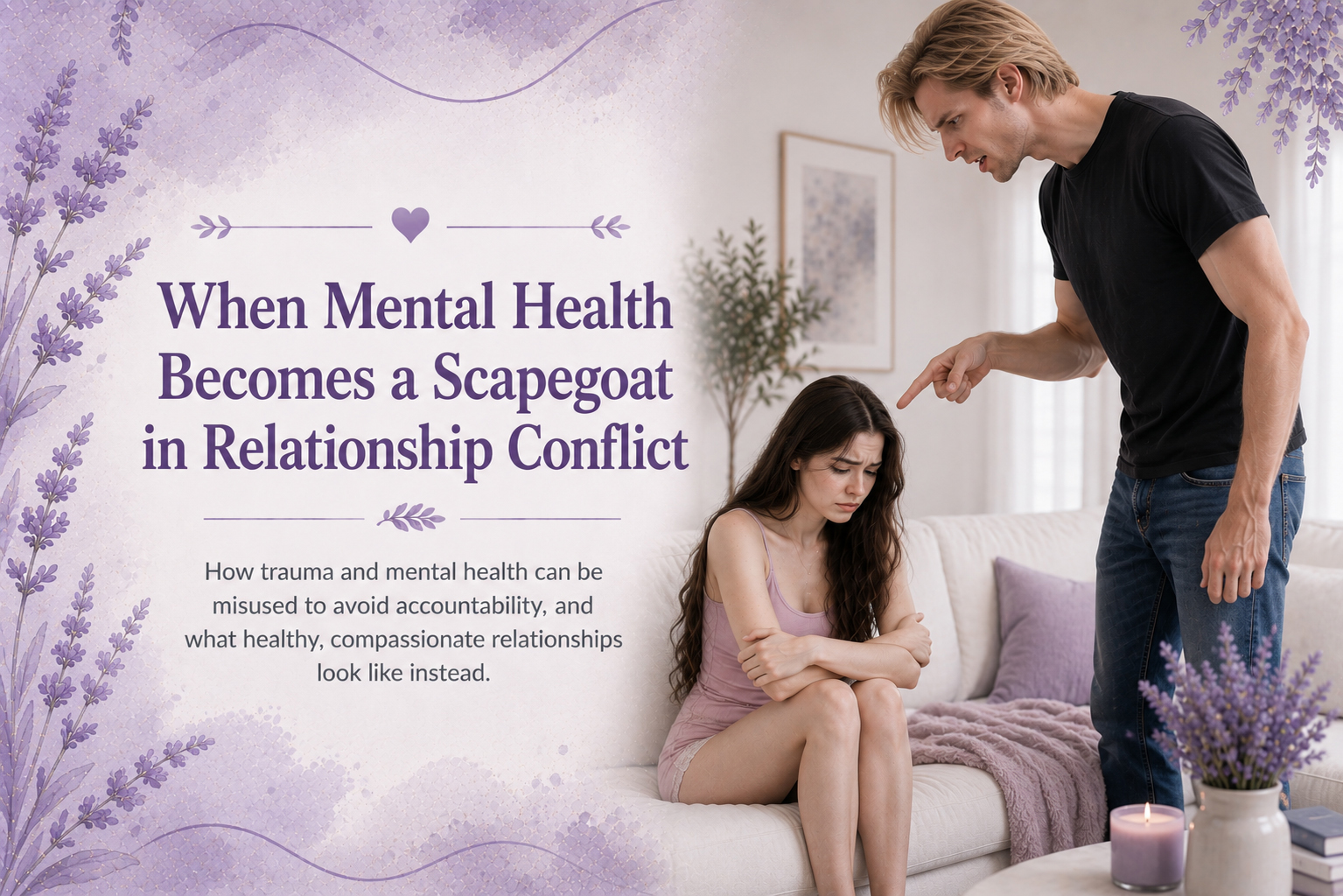
When Mental Health Becomes a Scapegoat in Relationship Conflict
Sometimes one person in a relationship has a trauma history, anxiety, depression, ADHD, autism, or another mental health concern that clearly affects how conflict unfolds. A disagreement may activate an old fear. A relatively small rupture may feel enormous. Feedback may trigger defensiveness, panic, anger, or an urgent need for reassurance.
Recognizing that influence can be compassionate and useful. It can help both partners understand why a conversation became so emotionally intense and what might help them handle a similar moment differently in the future.
But mental health language can also be misused.
Instead of helping a couple understand a conflict, it can become a shortcut for explaining the entire conflict away. One partner's trauma, diagnosis, or emotional vulnerability becomes the answer to every question:
“This only bothers you because of your past.”
“You are reacting this way because you are mentally unwell.”
“Nothing I did was really the problem.”
“You need to fix yourself instead of making this about me.”
At that point, mental health has stopped being one relevant part of the story. It has become a scapegoat that allows the other partner to step outside the story altogether.
A Trauma History Can Shape a Reaction Without Making the Concern Invalid
People sometimes speak about trauma responses as though identifying one automatically disproves the concern underneath it.
A person says that a partner’s sexual difficulty, emotional withdrawal, broken promise, or sudden change in behaviour frightened them. The partner responds by pointing out that they have abandonment trauma, sexual trauma, or a history of being neglected.
That history may explain why the reaction was particularly intense. It does not necessarily mean the present-day situation was harmless.
A smoke alarm can be unusually sensitive and there can still be smoke in the room.
Someone who experienced years of emotional or sexual neglect may understandably react more strongly to signs that intimacy could become difficult again. Someone who has repeatedly been abandoned may feel more alarmed when a partner suddenly withdraws. Someone with rejection sensitivity may experience criticism more intensely than another person would.
Those vulnerabilities matter. The person carrying them has a responsibility to learn how they operate, regulate their reactions, and communicate without attacking or overwhelming their partner.
But the other partner still has a responsibility to examine what actually happened in the present.
Trauma-informed communication asks two questions at once:
“How might this person’s past be affecting their reaction?”
and
“What happened between us today that genuinely deserves attention?”
It does not use the first question to erase the second.
Explanation Is Not Exoneration
One of the most important principles in relationship repair is that understanding why someone behaved a certain way does not make the behaviour disappear.
Anxiety may explain why someone sought reassurance repeatedly. It does not mean their partner was obligated to provide reassurance indefinitely.
Rejection sensitivity may explain why someone became defensive after receiving difficult feedback. It does not mean everything they said defensively was reasonable.
Trauma may explain why someone raised a concern with more urgency or fear than the situation warranted. It does not mean the underlying concern was invented.
Likewise, feeling criticized may explain why a partner withdrew, argued, or became preoccupied with proving that the criticism was unfair. It does not automatically make those responses constructive.
Explanations should help people take responsibility more accurately. They should not become legal defences used to eliminate responsibility altogether.
A healthy version sounds like:
“I can see why I reacted that way, and I still need to own what I did.”
An unhealthy version sounds like:
“I reacted that way because of what you did, so my reaction is ultimately your responsibility.”
The Difference Between Fault and Responsibility
Couples often get stuck because they treat fault and responsibility as the same thing.
A person may not be at fault for having anxiety, trauma, erectile dysfunction, rejection sensitivity, or difficulty regulating emotion. None of these concerns makes someone bad, defective, or unworthy of a relationship.
Responsibility asks a different question:
“Now that this difficulty exists, who is responsible for responding to it?”
A useful way to separate responsibility is to look at four different layers.
The original vulnerability
Each person is responsible for learning about and managing their own pre-existing vulnerabilities. One partner may bring trauma from a previous relationship. The other may bring performance anxiety, fear of criticism, difficulty tolerating uncertainty, or a tendency to perseverate after feeling rejected.
Neither partner caused the other’s history.
The present-day trigger
A trigger is something that activates an existing vulnerability. Sometimes the trigger is relatively innocent. Sometimes it is genuinely hurtful. Often it is a mixture of both.
A partner may communicate a real concern in an unnecessarily harsh way. That delivery can intensify the other person’s anxiety without creating the anxiety from nothing.
The reaction
Once activated, each person remains responsible for what they do with that activation.
One partner may become critical, send overwhelming messages, or speak in absolutes. The other may demand repeated reassurance, become defensive, withdraw affection, or repeatedly pressure the first partner to admit that the entire problem belongs to them.
Both reactions can worsen the cycle. Neither reaction becomes the other person’s property simply because it was triggered by something they said.
The repair
Finally, both people are responsible for whatever repair is possible.
Repair requires each person to identify their own behaviour clearly. It cannot work when one partner’s position is essentially, “I would have behaved perfectly if you had not caused me to become this way.”
That position gives one person all the pathology and the other all the innocence. Real relationships are rarely organized so neatly.
When Mental Health Language Becomes Stigmatizing
Mental health stigma is not limited to calling someone “crazy” or openly mocking a diagnosis. It can also appear in more sophisticated language.
A partner may use psychological concepts accurately enough to sound compassionate while still reducing the other person to a diagnosis or history.
This may look like:
- Treating every disagreement as a symptom.
- Assuming a partner’s feelings are less credible because they have trauma.
- Claiming to know the psychological reason for a concern instead of listening to the concern itself.
- Describing a dysregulated period as proof that the person’s loving or competent self was never real.
- Framing oneself as the rational observer and the other partner as the psychologically defective one.
- Expecting the person with the identified mental health history to accept responsibility for the whole relationship cycle.
This is stigmatizing because it makes one person’s psychological history more important than their present-day perspective, values, boundaries, and lived experience.
A person can have complex PTSD and still accurately perceive that something hurt them.
A person can have anxiety and still identify a genuine incompatibility.
A person can be autistic and still recognize that a partner is being dismissive.
A person can have rejection sensitivity and still deserve a sincere apology.
Mental health difficulties may affect the intensity, expression, or interpretation of a concern. They do not automatically invalidate the concern.
When this pattern becomes persistent and one-sided, when a partner consistently uses someone’s trauma or diagnosis to dismiss their concerns, avoid accountability, and rewrite the story so that nothing is ever their fault, it can cross into emotional abuse. The distinction is not a single mishandled conversation. It is a pattern in which one partner is never allowed to be right, hurt, or credible, while the other partner is never required to examine their own behaviour.
Erectile Dysfunction: Whose Responsibility Is It?
Erectile dysfunction illustrates these distinctions particularly well because it affects two people while occurring in one person’s body.
The condition itself is not a moral failure. A man should not be mocked, humiliated, or treated as less masculine because he experiences erectile difficulty. Shame and performance pressure can worsen psychogenic ED, making harsh criticism particularly unhelpful.
At the same time, erectile dysfunction is not emotionally neutral for the receiving partner.
A partner may feel rejected, undesirable, lonely, sexually unfulfilled, or afraid that the problem will become chronic. Someone who previously experienced years of sexual neglect may find the situation particularly frightening. Those feelings are not automatically unfair simply because they are influenced by history.
Persistent erectile difficulty also deserves proper assessment. Erectile dysfunction can have physical, psychological, medication-related, situational, and relationship-related contributors. Current clinical guidelines recommend a comprehensive medical and sexual history, appropriate examination and testing, and psychological or cognitive behavioural treatment when indicated, sometimes with the partner included. It should not simply be assumed that the partner’s emotional reaction caused the entire problem.
The primary responsibilities of the person experiencing ED include:
- Seeking appropriate medical evaluation.
- Considering reasonable treatment options.
- Learning to manage performance anxiety without outsourcing all emotional regulation to a partner.
- Communicating clearly about attraction, affection, and what is happening.
- Remaining interested in the partner’s experience rather than treating their hurt as an additional burden.
The receiving partner has responsibilities too:
- Raising concerns without humiliation or contempt.
- Avoiding statements that equate erections with masculinity, love, or human worth.
- Allowing room for assessment and improvement rather than demanding immediate perfect performance.
- Managing their own trauma responses without bringing in urgency or intensity that creates pressure.
These responsibilities are not identical because the problem does not exist identically for both people. But both experiences matter.
A partner’s harsh presentation may increase performance anxiety. That does not make them responsible for the other person’s entire subsequent anxiety cycle. Likewise, the man’s erectile difficulty may activate old trauma. That does not make him responsible for everything the receiving partner says while activated.
Compassion Is Not the Same as Emotional Outsourcing
Supporting an anxious partner is part of intimacy. Becoming their permanent external regulator is not.
After a distressing sexual or emotional event, reassurance can be loving and appropriate. Problems arise when reassurance becomes repetitive, compulsory, or ineffective: the same fundamental question is asked again and again, each answer produces only temporary relief, and the other partner is increasingly pressured to say something that will permanently remove the anxiety.
No answer can usually accomplish that.
The person seeking reassurance may genuinely be suffering. Their distress deserves compassion. But the long-term answer must include building an internal capacity to tolerate uncertainty, challenge catastrophic interpretations, and recognize when the mind has entered a repetitive loop.
Otherwise, the supportive partner eventually becomes responsible not only for their own feelings and behaviour, but also for continuously preventing the other person from feeling anxious.
That arrangement is exhausting and ultimately ineffective.
What Mutual Accountability Sounds Like
Mutual accountability does not require both partners to have contributed equally. It requires both partners to remain visible in the story. Rebuilding trust after conflict is possible, as covered in our previous article.
A one-sided account sounds like:
“Your trauma caused this entire conflict. I spent weeks trying to make you take responsibility. Until you fix yourself, there is nothing for me to examine.”
A mutually accountable account sounds more like:
“The way you raised this issue hurt and frightened me. I need you to recognize the pressure your words created. I also became preoccupied with obtaining reassurance and repeatedly tried to make you accept my explanation of what had happened. I can see that this made you feel dismissed and pressured. We both need a different way of responding.”
The second statement does not excuse the initial hurt. It simply refuses to pretend that only one person made choices after the initial moment.
Two truths can coexist:
“You communicated your concern in a hurtful way.”
and
“I responded to that hurt in ways that prolonged and intensified the conflict.”
That is usually the level of complexity real repair requires.
What an Effective Apology Actually Does
An apology is not a confession that the whole relationship problem was your fault.
A good apology identifies the speaker’s own contribution accurately. It does not bargain for an equal apology in the same sentence, but it also does not require the speaker to accept responsibility for another person’s choices.
An effective apology generally includes:
- A specific acknowledgment of the behaviour.
- Recognition of its impact.
- Clear ownership without immediately transferring the blame back.
- Relevant context that explains but does not excuse.
- An offer of repair.
- A credible description of what will change.
For example:
“I am sorry I spoke about your sexual difficulty in a way that made you feel judged and pressured. My history made the situation frightening for me, but I should have communicated that fear with more care. I will raise concerns more gently and allow space for proper assessment rather than treating one experience as proof of the future.”
The other partner’s apology might sound like:
“I am sorry I kept pushing you to accept my interpretation of your reaction and treated your trauma as though it explained everything. I was frightened and wanted certainty that the relationship was safe, but repeatedly seeking reassurance made you responsible for regulating that fear. I also minimized how the experience affected you. I will seek appropriate help and talk about my anxiety without demanding that you take ownership of it.”
Neither apology erases the other person’s contribution. Each person simply cleans up their own side of the conflict.
Research on apologies consistently finds that accountability and a meaningful offer of repair are among the elements that make an apology effective. An apology is most useful when it demonstrates that the speaker understands the injury and is prepared to behave differently, rather than merely wanting the uncomfortable conversation to end.
Common Questions About Mental Health, Blame, and Relationship Conflict
Is it stigmatizing to point out that trauma influenced a partner’s reaction?
Not necessarily. Trauma affects how people interpret and respond to present-day events, and discussing that influence can be helpful. It becomes stigmatizing when trauma is used to invalidate the person’s entire perspective, explain away every concern they raise, or excuse the other partner from examining their own behaviour.
Can a trauma response still be harmful?
Yes. Trauma responses are involuntary at the point of activation, but people remain responsible for learning how to manage their behaviour once activated. Understanding a trauma response should reduce shame and guide treatment, not give the response unlimited authority over the relationship.
Can scapegoating a partner’s mental health be a form of emotional abuse?
It can be, particularly when the pattern is persistent and one-sided. A single conversation where mental health language is used clumsily is not the same as a repeated pattern in which one partner’s trauma or diagnosis is used to dismiss every concern, avoid any self-examination, and place responsibility for the entire relationship onto the person carrying the diagnosis. When that pattern is consistent, it functions as a form of emotional abuse rather than an occasional communication misstep.
If mental health language has started to feel like a way to explain away conflict rather than understand it, whether you are the one raising a concern or the one carrying a diagnosis, working with a therapist can help your relationship find its way back to mutual accountability. Pacific Maple Psych Centre offers individual and couples therapy in Vancouver for trauma, anxiety, and relationship conflict.
Book a SessionDoes acknowledging my trauma mean admitting that the conflict was entirely my fault?
No. You can acknowledge that your history increased the intensity of your reaction while still identifying what your partner did in the present. Accountability should become more precise, not more totalizing.
Is erectile dysfunction the responsibility of the man experiencing it?
The condition is not his moral fault, but seeking evaluation, considering treatment, communicating openly, and learning to manage associated anxiety are primarily his responsibilities. His partner may participate supportively, but she is not responsible for causing, curing, or endlessly regulating the condition. Both partners remain responsible for how they communicate about its impact.
What if one partner really did contribute more to the conflict?
Mutual accountability does not require pretending every conflict was exactly equal. One person may have caused substantially more harm. The goal is simply to avoid a narrative in which one partner becomes the complete psychological explanation for everything while the other partner’s choices disappear.
Getting Support in Vancouver
When trauma, neurodivergence, sexual difficulty, anxiety, or rejection sensitivity becomes part of a relationship conflict, couples often need help separating several questions that have become tangled together:
- What happened in the present?
- What came from the past?
- What belongs to each person?
- What needs an apology?
- What needs treatment, a boundary, or a practical change?
Pacific Maple Psych Centre offers individual and couples therapy in Vancouver for people trying to answer these questions without reducing either partner to a diagnosis. Therapy can help couples understand how mental health shapes their interaction while preserving something equally important: the agency, dignity, and responsibility of both people.
Holding Both Truths at Once
Your history may explain why something hurt as much as it did. It does not prove that nothing hurt you. Your partner may have activated an old wound. That does not make them responsible for healing every part of it. You may have communicated from a place of fear. That does not erase the impact of your words. Your partner may have been hurt by those words. That does not make every response they chose afterward your responsibility.
Mental health belongs in the relationship story. It should never become the entire story.
The most compassionate account is rarely the one that identifies which person is psychologically defective. It is the one that allows both people to remain fully human: influenced by their histories, accountable for their choices, capable of hurting each other, and capable of doing better.
Pacific Maple Psych Centre offers individual and couples therapy in Vancouver for trauma, anxiety, and relationship conflict. If this article sounds familiar, you do not have to work through it alone.
Book Your Session TodaySources
- Atallah, S., Haydar, A., Jabbour, T., Kfoury, P., & Sader, G. (2021). The effectiveness of psychological interventions alone, or in combination with phosphodiesterase-5 inhibitors, for the treatment of erectile dysfunction: A systematic review. Arab Journal of Urology, 19(3), 310–322.
- Downey, G., & Feldman, S. I. (1996). Implications of rejection sensitivity for intimate relationships. Journal of Personality and Social Psychology, 70(6), 1327–1343.
- Johnson, S. M., & Brubacher, L. L. (2016). Clarifying the negative cycle in emotionally focused couple therapy (EFT). In G. Weeks, S. Fife, & C. Peterson (Eds.), Techniques for the Couple Therapist: Essential Interventions (pp. 92–96). Routledge.
- Lewicki, R. J., Polin, B., & Lount, R. B. (2016). An exploration of the structure of effective apologies. Negotiation and Conflict Management Research, 9(2), 177–196.
- Rector, N. A., Kamkar, K., Cassin, S. E., Ayearst, L. E., & Laposa, J. M. (2011). Assessing excessive reassurance seeking in the anxiety disorders. Journal of Anxiety Disorders, 25(7), 911–917.
- Substance Abuse and Mental Health Services Administration. (2014). SAMHSA’s Concept of Trauma and Guidance for a Trauma-Informed Approach. U.S. Department of Health and Human Services.